A few years ago, on a scorching Friday afternoon in rural Ramona, California, something small, screechy, and slightly gremlin-like crash-landed into the life of our Fairy Owlet Mother, Stacey Mae Rudge.
That “something” was Gizmo—a fluffy, flailing owl chick with the energy of a caffeinated toddler and the vocal range of a horror movie villain.
Here’s the story of how it all went down.
A Cabbage Patch Emergency
It started with a phone call. A local farming family who rents land about half a mile down Stacey’s road, had an old owl box in one of their fields.
And beneath it, nestled awkwardly in a patch of cabbage, they spotted a baby barn owl chick that had fallen from the nest.
They called Stacey and she rushed to the scene (on a Friday, naturally, when all the wildlife rescues were closed—because emergencies love a good challenge). The first owlet found in the cabbage patch didn’t make it. But hours later, the phone rang again.
“There’s another one.”
Stacey and her husband jumped into action for the second rescue. This one, still wide-eyed and wild, was shrieking and flapping like a feathered firecracker.
“It was like Gizmo from the Gremlins,” Stacey said. “Just absolutely bonkers. Laughing, screeching, climbing the walls. So naturally… we named him Gizmo.”

A Makeshift Owl ICU
With no rescue centers open and the sun baking the valley, Stacey had to think fast.
Luckily, tucked away on her property is a screened-in greenhouse garden retreat that is the perfect big bird cage: high ceilings, tons of airflow, and plenty of space for a stunned young fledgling to flap its way back to normal.
“I put Gizmo in there with some frozen mice, water, and shade. He wasn’t far off from flying—just a bit stunned and probably overheated.”
Baby barn owls are especially vulnerable to heat stress in cramped nest boxes. When nest boxes get too hot and stuffy, young barn owls sometimes panic-jump to escape the heat. That’s likely what happened here—twice.
So Stacey monitored him closely all weekend, texting her mentor (a seasoned wildlife rescuer) with photos and updates.
And Gizmo? He ranted, raved, and glared at her through the mesh like a tiny, furious dictator. But he was safe. And he was healing.
A Wild Idea: Owl Adoption
Here’s where things get magical.
Stacey had another clutch of owlets about the same age just up the hill in one of her nest boxes.
She’d seen this group “adopt” orphaned owlets before. Two in fact—Cousin Oliver and Xena: Princess Warrior—had mysteriously appeared one morning and been fully accepted by the family. The owl parents didn’t miss a beat.
She realized barn owl parents are surprisingly generous when it comes to raising extra barn owl chicks—especially when the new arrival is the same size and stage as their own barn owl babies.
So instead of taking Gizmo out of his environment and bringing him to the rescue center, Stacey thought, “Maybe… he could go back in a box.”
But how do you sneak a surprise owlet into a 25-foot-high nest box without a boom lift, a magic wand, or an actual tree ladder? You MacGyver it.
The Owlevator
This is where our Fairy Owlet Mother’s husband earns some serious wings of his own.
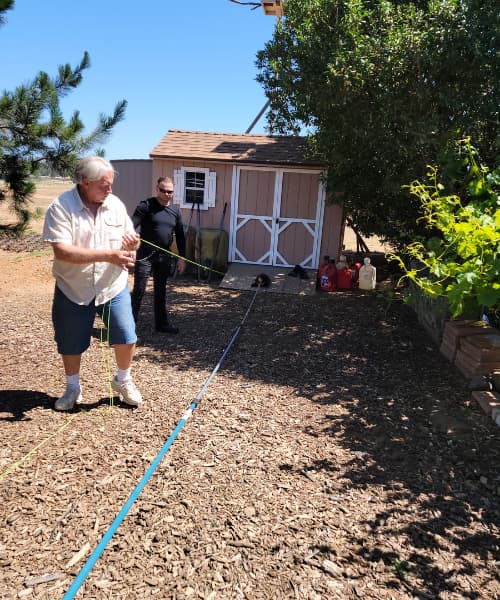
Armed with a vegetable basket, a pool extender pole, a towel, and pure genius, he constructed a makeshift “elevator.” They gently placed Gizmo inside, covered him with a towel (to keep him calm), and tied a string to it so it could be pulled away at the right moment.
Then… up he went. Twenty-five feet into the air.
“He missed the first step and almost fell,” Stacey laughed. “But then he scrambled in—and it was instant friendship. The other owlets loved him. There’s a video of him rubbing beaks and cuddling. We couldn’t even tell what he was doing—it looked like he was kissing them!”
The owl parents didn’t just tolerate Gizmo. They fed him. Protected him. Let him beg for snacks just like one of their own.
Gizmo may have looked like a feathered gremlin, but to the other owlets, he was just another hungry owl baby.
And within weeks, he fledged successfully.
The Best Surprise? It Worked.
But she wasn’t flying blind. She had guidance, she had grit, and she had a deep understanding of barn owl behavior—an understanding that’s now inspiring others.
Even the Humane Society recently reunited a fallen owlet using that same wild adoption method.
The takeaway? Owls are way more social—and generous—than people think.
“They’re wild animals, yes,” Stacey said. “But they’re incredibly kind. We joke that they are bad at math because they don’t count their kids. They just… make room.”
What Gizmo Taught Us About Owls
This fluffy little screecher didn’t just find a second chance—he taught us a whole lot about barn owl behavior along the way. Here’s what the rescue revealed:
1. Barn Owls Can’t Count
Seriously. You can sneak in an extra kid and they won’t notice. This is a real strategy used by wildlife rehabilitators now: insert an orphaned fledgling into a box with same-aged siblings, and often the owl parents just roll with it. As long as it’s fluffy and hungry, they’ll feed it.
2. They’re Incredibly Welcoming
Despite all the old-school talk about barn owls being territorial or competitive, Stacey has seen again and again how they adapt and accept. Cousins, strays, the one-eyed… they all get love in the nest box.
3. Rescue Doesn’t Always Mean Removal
If an owlet isn’t badly injured, the best solution might be to keep it near its original territory and reintroduce it to the wild family system. This keeps stress low and gives them their best shot at survival in the environment they were born into.
4. Creative Solutions Matter
Not every rescue needs a boom lift and a white coat. Sometimes it takes a towel, a net, a little elbow grease, and a whole lot of love. Stacey and her husband’s “owlevator” was not only clever—it saved a life.
A Happy Ending—and a New Nest Box
After the rescue, the story came full circle. The farming family who first called Stacey ended up swapping their crumbling old box for a brand-new Ramona Barn Owls box.
That’s what this is about—community, conservation, and connection.
And Gizmo?
He’s long gone now, likely swooping silently through the skies of San Diego County, hunting field mice and raising fluffy gremlin babies of his own.

Owl Rescue FAQ: What To Do If You Find a Fallen Owl Chick
I found a baby owl on the ground! Is it in danger?
Maybe… but maybe not. Barn owlets are little explorers, and sometimes they hop out of the nest when they are learning how to fly. If it looks fluffy, alert, and healthy (no blood, drooping wings, or closed eyes), it might just be in the gangly “brancher” stage. Keep your distance and observe it for a while. The parents may still be feeding it!
When should I intervene?
If the owlet looks injured, cold, or is in immediate danger on the ground (like near a road or a predator), gently place it in a box with air holes and contact a licensed wildlife rehabilitator ASAP. It’s okay to touch the owlet—contrary to myth, the parents will not reject their young if you intervene.
What do baby owls eat and can I feed one?
Baby owls eat whole prey like mice, small birds, or insects—depending on their species. But if you find a baby owl in the wild, it’s best not to feed it. Giving the wrong food can cause serious harm. As tempting as it is, leave the feeding to licensed wildlife rehabilitators who know exactly what owl chicks need to stay healthy.
Should I try to put a fallen baby owl back in the nest?
Only if it’s safe for you and the owlet. Never disturb an active owl box without knowing how the resident owls will react. That said, if you’re working with a licensed rehabber, creative re-nestings like Gizmo’s can work wonders.
Who should I call for help?
Reach out to raptor-specific rehabbers, owl organizations, or local conservation groups. Many will offer phone support or know someone nearby who can help. In the meantime, keep the newborn owl safe, calm, and in a cool, quiet place.
Can I keep it?
We know—they’re adorable. But no. In the U.S., it’s actually illegal to keep wild owls without special training and permits. Caring for sick or injured wildlife requires expert knowledge, proper facilities, and a whole lot of frozen mice. These birds belong in the wild—and that’s exactly where we want to help them stay.
Can barn owls really adopt orphans?
Yes! As Gizmo’s story shows, barn owls are remarkably flexible, especially when the “intruder” is the right age and shows up hungry and fluffy. Wild adoption is a growing rescue technique, and it works because barn owls don’t rely on scent or counting. They respond to need.
Final Thoughts
Gizmo’s story is a reminder that wildlife rehabilitation isn’t always about intervention. Sometimes it’s about restoration. About quietly stitching a little life back into the fabric of the wild, then stepping back to let nature do her thing.
Want to help more young owls like Gizmo?
Support our work by tuning into our 24/7 livestream, rocking one of our owl-inspired designs, or spreading the word about poison-free pest control.
![Warning: Highly Addictive Baby Owl Content. Peek into the nest 24/7 and fall in love with our live owls. [Watch the Livestream]](https://ramonabarnowls.com/wp-content/uploads/Warning-1.jpg)
![Book the Fairy Owlet Mother – Bring Stacey’s owl magic to your school or event. [Book a Presentation]](https://ramonabarnowls.com/wp-content/uploads/Book-the-Fairy-Owlet-Mother-1.jpg)


![Caught on Cam: My bros fall, flop, and sass it up—watch the bloopers on YouTube. [Watch Now]](https://ramonabarnowls.com/wp-content/uploads/Caught-on-Cam-1.jpg)
![Subscribe on YouTube – Join 1,000+ owl lovers following our live owl adventures. [Subscribe Now]](https://ramonabarnowls.com/wp-content/uploads/Subscribe-on-YouTube-1.jpg)

![Your New Favorite Hoodie Is Saving Owls. Literally. Ridiculously soft. Seriously impactful. [Shop the Collection]](https://ramonabarnowls.com/wp-content/uploads/Your-New-Favorite-Hoodie-1.jpg)
![Hoot Happiness Guarantee – Shop risk-free with free returns & exchanges. [Shop Now]](https://ramonabarnowls.com/wp-content/uploads/Hoot-Happiness-Guarantee-1.jpg)