Quick Overview:
- Owls are social with other owls, not with humans.
- Calm or still owl behavior can be mistaken for friendliness, but it’s usually a survival strategy.
- Owls avoid humans instinctively because distance and quiet increase their chances of survival.
- Owls may tolerate humans in certain situations, such as rehabilitation, habituation, or imprinting.
- Living near humans is not the same as wanting interaction with humans.
- Owls can appear defensive or aggressive when protecting nests or young, but they are not mean.
- Being friendly to owls means respecting their wild nature and giving them space to remain wild.
Are Owls Friendly to Humans?
Owls are friendly to each other — but they really don’t want anything to do with humans.
That’s just owl biology.
We see big eyes, fluffy feathers, and viral videos that make owls look calm, cuddly, or curious. To a human observer, that can look like comfort or even friendliness.
But owls are wild animals, designed to survive quietly, hunt efficiently, and avoid unnecessary interaction.
To understand why, we have to let go of human expectations and learn how owl behavior actually works.
Owls Are Social With Other Owls, Not With Humans
Owls do have social lives — just not with us.
Within their own species, owls communicate constantly. They use calls, body posture, and flight patterns to find mates, defend territory, and raise young.
Many owl species form long-term pair bonds and work together to protect their space and offspring. Those relationships are intentional and serve a clear purpose: survival.
Humans simply aren’t part of that system.
Avoiding large animals is a built-in survival instinct for birds of prey. Even when humans don’t pose an immediate threat, our unpredictability alone is enough reason for an owl to keep its distance.
That’s why birds of prey often leave a perch when someone approaches, even when there’s no chance of contact. It isn’t fear or aggression — it’s instinct.
Other times, an owl does the opposite.
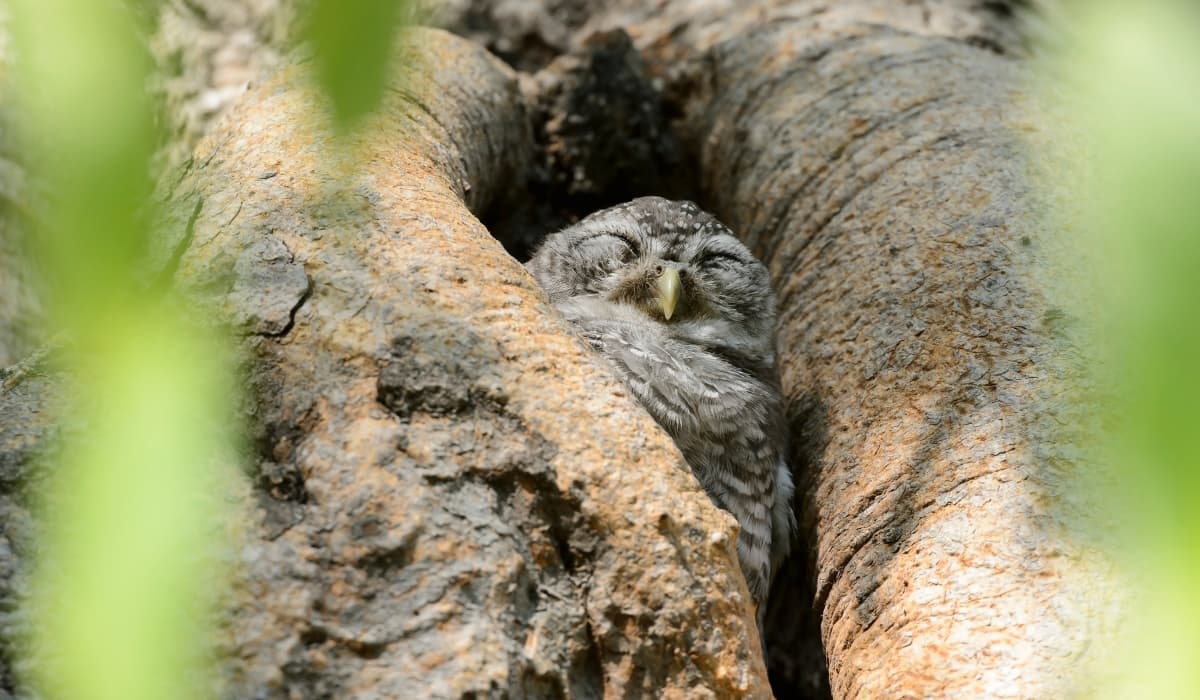
Instead of flying away, it stays completely still. That stillness isn’t an invitation for interaction. It’s another one of an owl’s most effective survival tools. Remaining motionless helps owls blend into their surroundings, conserve energy, and quietly assess risk before deciding what to do next.
Why Owls Don’t Want Human Interaction
Owls are built for quiet lives.
Everything about them — how they hunt, where they rest, how they raise young — depends on staying unnoticed. Silence, darkness, and distance aren’t preferences. They’re survival tools.
Owls don’t gain food, safety, or advantage from engaging with people. Being close to humans usually means more noise, more movement, and more unpredictability. From an owl’s perspective, that increases risk, not comfort.
In places where humans are consistently present, some owls adapt because they have no other choice. In the modern world, owls — like so many other wild animals — are often forced to adjust to human activity simply to survive. They may learn that certain sounds, routines, or movements aren’t immediately dangerous.
That adaptation allows owls to function in a changed environment, but it doesn’t mean they prefer it or seek it out. Tolerance is not comfort. It’s an owl making the best of the situation it’s been given.
Situations That Can Lead Owls to Tolerate Humans
Every now and then, you’ll see an owl that seems unusually comfortable around people. In most cases, something very specific is going on:
- Education or rehabilitation owls: These owls are around people because they have to be. They’re handled by trained professionals for medical care or educational programs, and over time they learn to tolerate human presence.
- Habituated wild owls: Some wild owls live in places where humans are constantly nearby. Over time, they learn which sounds, movements, and routines are predictable enough to ignore. That calm behavior is adaptation, not trust. The owl isn’t bonding — it’s managing its surroundings.
- Imprinted owls: Owls exposed to humans too early may associate people with food or care. These owls can appear unusually comfortable around humans, but imprinting puts them at serious risk. It disrupts normal survival behavior and often means the owl can’t live safely in the wild.
In each case, what looks like friendliness is simply an owl responding to circumstance.
Are Barn Owls Friendlier Than Other Owls?
If you’ve ever spent time in our Fairy Owlet Mother Stacey’s backyard — or watched the Ramona Barn Owls livestream — it’s easy to think so.
Barn owls are fluffy. And yes, they really are that cute, with their little heart-shaped faces that make people stop and stare.
They’re also often described as gentler or calmer than other birds of prey, and in some ways, that’s true. Barn owls will perch quietly and watch the world move around them. Instead of reacting dramatically, they tend to rely on stillness.
That stillness isn’t friendliness. It’s strategy.
Barn owls depend heavily on camouflage and restraint. Remaining motionless helps them avoid detection, conserve energy, and assess what’s happening around them without drawing attention. A subtle response doesn’t signal comfort — it signals calculation.
Part of the confusion may come from the name itself. Barn owls earned that name because they often nest in old barns and agricultural structures. These spaces happen to be closer to human activity than the more remote habitats used by some other owl species. Over time, barn owls have adapted to living near people — not because they want interaction, but because those structures offer safe nesting opportunities.
Living near humans is not the same as wanting to engage with them.
Are Owls Mean or Aggressive?
Owls aren’t mean. They’re just very serious about personal space.
When an owl feels threatened, it may hiss, snap its beak, or swoop nearby. These moments tend to happen during nesting season or when young owls are involved — basically, when an owl is in full “do not cross this line” mode.
Those behaviors aren’t attacks. They’re warnings.
Owls use sound, posture, and movement to create distance, not to pick a fight. A swoop is often meant to say, “Back up,” not “I’m coming for you.”
Owls don’t go looking for confrontation. They don’t hold grudges, and they aren’t acting out of anger. Their responses are situational and protective, driven by instinct rather than emotion.
In other words, if an owl seems aggressive, it’s usually because it’s doing its job — keeping itself, its nest, or its young safe.
Are Owls Good to Have Around?
Yes — environmentally speaking, owls are good to have around.
Barn owls, in particular, are incredibly efficient hunters. A single barn owl family can hunt up to 1,000 rodents in a year, helping keep local populations in balance. That kind of natural rodent control is far safer and more effective than relying on rodenticides, which don’t stop at rats. Poisoned rodents move up the food chain, harming owls, hawks, pets, and other wildlife along the way.
From that perspective, owls can be incredibly beneficial to have nearby. It’s no surprise that many people enjoy knowing owls are in the area, especially in rural or semi-rural settings.
If you’d like to attract owls to your backyard, the best approach is to give them what they actually need: safe habitat, quiet space, and the ability to hunt without risk.
That means:
- Providing safe nesting options
- Avoiding rodenticides (wildlife poisons) and other non-target pest control methods
- Preserving natural hunting areas
Can You Have an Owl as a Pet?
No — owls are wild animals, not pets.
Owls are protected wild birds under both federal law and state wildlife regulations. Keeping one without the proper permits is illegal. Federally, all native owl species are protected under the Migratory Bird Treaty Act, which means private ownership isn’t allowed.
At the state level, many states — including California — treat owls the same way they treat other birds of prey: as wildlife that belongs to everyone, not something an individual can own as a pet.
These laws exist for a reason. Owls don’t do well in captivity without highly specialized care, space, and training. Keeping an owl as a pet isn’t just illegal — it’s harmful to the owl’s welfare.
How Can We Be Friendly to Owls
So, are owls friendly?
Yes — to each other. Toward humans, not in the way we usually mean the word.
Owls don’t need our human interactions to thrive. They need space, safety, and the freedom to remain wild.
That starts with keeping a respectful distance and letting them exist on their own terms.
If you want to be friendly to owls, the most meaningful ways are often indirect:
- Learn how owls actually live
- Share accurate information with others
- Support education and conservation efforts
- Choose products and practices that reduce harm
At Ramona Barn Owls, our mission is rooted in coexistence. Supporting owls means helping people understand ethical wildlife behavior, advocating for poison-free rodent control, and creating safer environments where owls can thrive — quietly, independently, and wild.
You can support the mission by shopping our owl apparel, following along to learn more, watching our barn owl livestream, or joining us in spreading awareness.
Every small action helps create a world where owls don’t have to adapt quite so hard to survive alongside us.
![Every Tee Tells a Story – From rescues to rodent control, our designs speak up for owls. [Shop Owl-Inspired Apparel]](https://ramonabarnowls.com/wp-content/uploads/Every-Tee-Tells-a-Story-1.jpg)
![Book the Fairy Owlet Mother – Bring Stacey’s owl magic to your school or event. [Book a Presentation]](https://ramonabarnowls.com/wp-content/uploads/Book-the-Fairy-Owlet-Mother-1.jpg)

![Matching fits for the whole flock. Because protecting wildlife is even sweeter when you do it together. [Shop the Family Collection]](https://ramonabarnowls.com/wp-content/uploads/Matching-fits-for-the-whole-flock-1.jpg)


![Ridiculously Soft Whoo-Wear [Shop Now]](https://ramonabarnowls.com/wp-content/uploads/Ridiculously-Soft-Whoo-Wear-1.jpg)
![Hoot Happiness Guarantee – Shop risk-free with free returns & exchanges. [Shop Now]](https://ramonabarnowls.com/wp-content/uploads/Hoot-Happiness-Guarantee-1.jpg)
![Subscribe on YouTube – Join 1,000+ owl lovers following our live owl adventures. [Subscribe Now]](https://ramonabarnowls.com/wp-content/uploads/Subscribe-on-YouTube-1.jpg)