Quick Overview
- Barn owls and barred owls are often confused because they’re similar in size and active around dusk
- Face shape is the fastest way to tell them apart: heart-shaped vs. round
- Barn owls favor open fields and silent flight, while barred owls live in forests and hunt from perches
- Their calls are completely different: screeching vs. classic hooting
Barn Owl vs. Barred Owl
Barn owls and barred owls are commonly confused, especially by people who catch only a quick glimpse at dusk or hear an owl calling from the trees.
But while they may seem similar at first glance, these two owls are very different birds once you know what to look (and listen) for.
Let’s break down some similarities and differences.
Quick Comparison: Barn Owl vs. Barred Owl
Here’s a quick look at how these two species of owls stack up next to each other.
| Feature | Barn Owl (Tyto alba) | Barred Owl (Strix varia) |
|---|---|---|
| Face shape | Heart-shaped facial disc | Round facial disc |
| Face color | White to pale cream | Brown with dark concentric rings |
| Body color & pattern | Light creamy body with fine speckling | Brown body with horizontal bars and vertical streaks |
| Typical habitat | Open fields, grasslands, farms barns | Forests, wooded wetlands, river corridors |
| Activity pattern | Mostly nocturnal | Active day and night |
| Vocalization | High-pitched screech – does not hoot | Classic hooting call “Who cooks for you?” |
| Nesting style | Barns, cavities, nest boxes | Tree cavities |
| Hunting style | Low silent flight over open ground | Perch-and-pounce from trees |
| Primary diet | Mostly rodents | Rodents birds amphibians reptiles |
| Overall impression | Ghostly, quiet, elegant | Stocky, vocal, bold |
Why People Confuse Barn Owls and Barred Owl
Before diving into what sets barn owls and barred owls apart, it helps to understand why they’re so often confused in the first place. On the surface, they actually share several similarities — especially when sightings are brief or happen in low light.
Here’s where the confusion starts:
- Both are large owls, much bigger than what most people expect
- Both are common across North America, making either one a realistic possibility in many regions
- Both are active around dusk, when lighting conditions make details hard to pick out
- Most encounters are quick — a flyby, a silhouette in a tree, or a sudden movement at the edge of vision
- From a distance, their size and overall shape can look similar, especially against the sky or a dark tree line
Because of this, a quick glance is rarely enough to confidently identify which owl you’re seeing. But while these similarities explain the mix-up, they also hide some very prominent differences.
Once you start paying attention to things like face shape, habitat, vocalizations, and hunting style, the contrast becomes clear.
What initially looks like “the same owl” quickly turns into two very different species with distinct behaviors, lifestyles, and roles in the ecosystem.

Differences Between Barn Owl and Barred Owl
Face Shape: The Biggest Visual Clue
If you remember one thing, make it this:
- Heart = barn owl
- Round = barred owl
Barn owls have a heart-shaped facial disc that acts like a satellite dish, funneling sound straight to their ears. This gives them extraordinary hearing and allows them to hunt in complete darkness.
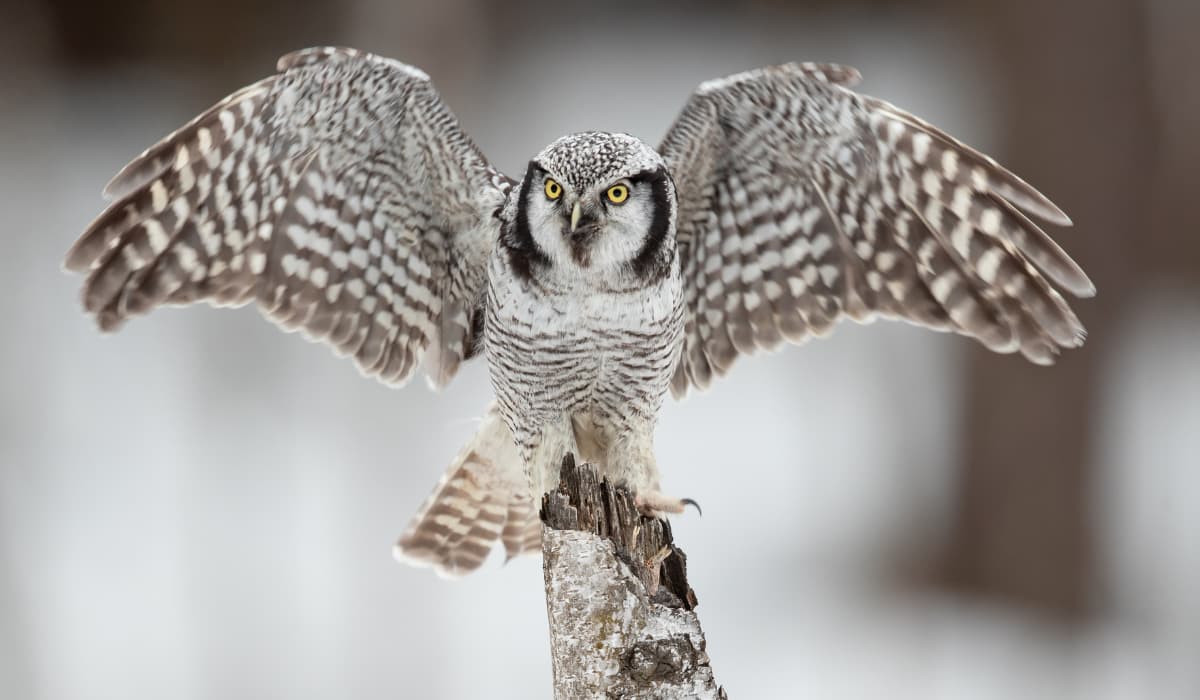
Barred owls have a round facial disc, more typical of “classic” owls, and rely more evenly on sight and sound.
This difference alone can usually settle the debate.
Color & Feather Pattern: Light vs. Barred
Barn owls are pale and ghostly, often appearing white or cream as they fly. Their backs are lightly speckled, and their undersides are bright — which is why people sometimes describe them as “floating” through the night.
Barred owls are darker and heavier-looking, with brown feathers marked by horizontal bars across the chest and vertical streaks on the belly. They blend beautifully into tree bark and forest shadows.
If the owl looked light and almost glowing = barn owl
If it looked dark and blended into trees = barred owl
Habitat: Fields vs. Forests
Barn owls and barred owls don’t just look different — they live in very different neighborhoods.
Barn owls prefer:
- Open grasslands
- Agricultural fields
- Ranches and barns
- Nest boxes near open hunting areas
Barred owls prefer:
- Dense forests
- Wooded wetlands
- River corridors
- Mature trees with cavities
Sounds: Screech vs. Storybook Hoot
Owl calls are often one of the easiest ways to tell barn owls and barred owls apart.
Barn owls do not hoot.
They screech and click — harsh, raspy, and unforgettable.
Barred owls are famous hooters.
Their call is sometimes said to sound like someone’s saying: “Who cooks for you? Who cooks for you all?”
Ramona Barn Owls Insider Tip: If you hear a classic “hoo-hoo” in San Diego, you might actually be hearing a Great Horned Owl. These are much more common in our local area than the Barred Owl. Both the Barred and Great Horned hoot, but the Barn Owl strictly screeches and clicks!
If you hear hooting = barred owl (or a Great Horned Owl locally).
If you hear screaming/clicking = barn owl
Hunting Style & Behavior
Barn owls are specialized rodent hunters. Their long wings and lightweight bodies let them fly slowly and silently, hovering low over fields while listening for movement below.
Barred owls are generalists. They’ll hunt rodents, birds, frogs, reptiles — whatever’s available — often from a perch before swooping down.
Different wings.
Different strategies.
Same goal: dinner.
Size, Wings, and Overall Build
While barn owls and barred owls can look similar in size at a glance, their bodies are built for very different lifestyles.
Barn owls tend to have longer wings relative to their body size, giving them a lighter, more delicate appearance in flight. This wing shape allows them to fly slowly and silently over open ground while listening for prey below. Their bodies are slimmer, and their movements often look smooth and floating rather than powerful.
Barred owls, on the other hand, have a stockier, more muscular build. Their wings are broader and designed for short bursts of flight between trees rather than long glides over open fields. When a barred owl flies, it often looks more direct and purposeful, especially when moving from perch to perch within a forest.
Why Knowing the Difference Matters
Learning how to tell barn owls and barred owls apart helps us better understand how each species fits into its environment.
When we know where an owl lives, how it hunts, and what it needs to survive, it’s easier to protect the spaces that keep it thriving.
By slowing down and noticing the differences, we move from a quick “Hey, an owl!” moment to genuine appreciation — and that kind of awareness is often the very first step toward real, lasting conservation.
Final Thoughts
It’s easy for people to mix up barn owls and barred owls at first glance, but once you slow down and really look — or listen — the differences start popping out everywhere.
From face shape and habitat to sound and hunting style, each species is uniquely adapted to its environment.
And regardless of their differences, both are worth protecting.
That’s why education and conservation are at the heart of our mission at Ramona Barn Owls.
Whether it’s through school visits, community outreach, or sharing accurate information online, our goal is to help people see owls as essential members of a healthy ecosystem.
If you’d like to learn more about barn owls, support conservation efforts, or bring owl education to your school or community, we invite you to explore more of what we do.
Barn Owl vs. Barred Owl FAQs
Are barn owls and barred owls closely related?
Barn owls and barred owls are not closely related, even though they are both owls. Barn owls belong to the Tytonidae family, while barred owls are part of the Strigidae family, which includes most of the “typical” owls. Their similar size can make them look related, but they are evolutionarily quite different.
Which owl is more likely to live near people, barn owls or barred owls?
Both barn owls and barred owls can live near people, but they do so in different ways. Barn owls often nest in barns, silos, and man-made nest boxes near open fields, while barred owls usually remain in wooded areas, even when those forests are close to neighborhoods or parks.
Which owl is more active during the day, barn owls or barred owls?
Barred owls are more active during the day than barn owls. Barn owls are primarily nocturnal and typically stay hidden during daylight hours, while barred owls may hunt or call during the day as well as at night.
Do barn owls and barred owls compete with each other?
Barn owls and barred owls do not often compete with each other because they use different habitats and hunting strategies. Barn owls focus on open fields and grasslands, while barred owls hunt within forests and wooded areas, which reduces direct competition for food.
Can barn owls and barred owls be identified by sound alone?
Barn owls and barred owls can often be identified by sound alone. Barred owls produce classic hooting calls, while barn owls make harsh screeches and hissing sounds instead of hoots, making vocalizations one of the fastest ways to tell them apart.
Are barn owls endangered or are barred owls endangered?
Barn owls and barred owls are not globally endangered species. However, local populations—especially barn owls—can decline due to habitat loss, reduced nesting sites, and changes in land use, which is why conservation and education efforts remain important
![Every Tee Tells a Story – From rescues to rodent control, our designs speak up for owls. [Shop Owl-Inspired Apparel]](https://ramonabarnowls.com/wp-content/uploads/Every-Tee-Tells-a-Story-1.jpg)
![Book the Fairy Owlet Mother – Bring Stacey’s owl magic to your school or event. [Book a Presentation]](https://ramonabarnowls.com/wp-content/uploads/Book-the-Fairy-Owlet-Mother-1.jpg)

![Matching fits for the whole flock. Because protecting wildlife is even sweeter when you do it together. [Shop the Family Collection]](https://ramonabarnowls.com/wp-content/uploads/Matching-fits-for-the-whole-flock-1.jpg)


![Ridiculously Soft Whoo-Wear [Shop Now]](https://ramonabarnowls.com/wp-content/uploads/Ridiculously-Soft-Whoo-Wear-1.jpg)
![Hoot Happiness Guarantee – Shop risk-free with free returns & exchanges. [Shop Now]](https://ramonabarnowls.com/wp-content/uploads/Hoot-Happiness-Guarantee-1.jpg)
![Subscribe on YouTube – Join 1,000+ owl lovers following our live owl adventures. [Subscribe Now]](https://ramonabarnowls.com/wp-content/uploads/Subscribe-on-YouTube-1.jpg)