Quick Overview
- Scientific name: Strix varia
- Average size: 16–20 inches tall
- Wingspan: 39–44 inches
- Weight: Around 16–37 oz
- Habitat: Forests, swamps, wooded neighborhoods, and river corridors
- Diet: Rodents, frogs, snakes, birds, crayfish, rabbits, and other small animals
- Lifespan: Around 8–10 years in the wild
- Known for: Their famous “Who cooks for you?” call
Barred Owls
Barred owls are one of the most recognizable owls in North America thanks to their haunting calls, dark eyes, and their ability to make an entire forest sound mildly haunted at 2 a.m.
They’re large woodland owls native to North America and are especially common throughout the eastern United States, though over time they’ve expanded farther west into parts of the Pacific Northwest and California.
And despite being pretty famous in the owl world, barred owls are still surprisingly misunderstood. People constantly mix up barred owls with barn owls, assume they’re dangerous, or have no idea they’ve become part of one of the biggest owl conservation debates in the United States.
Barred Owl Features
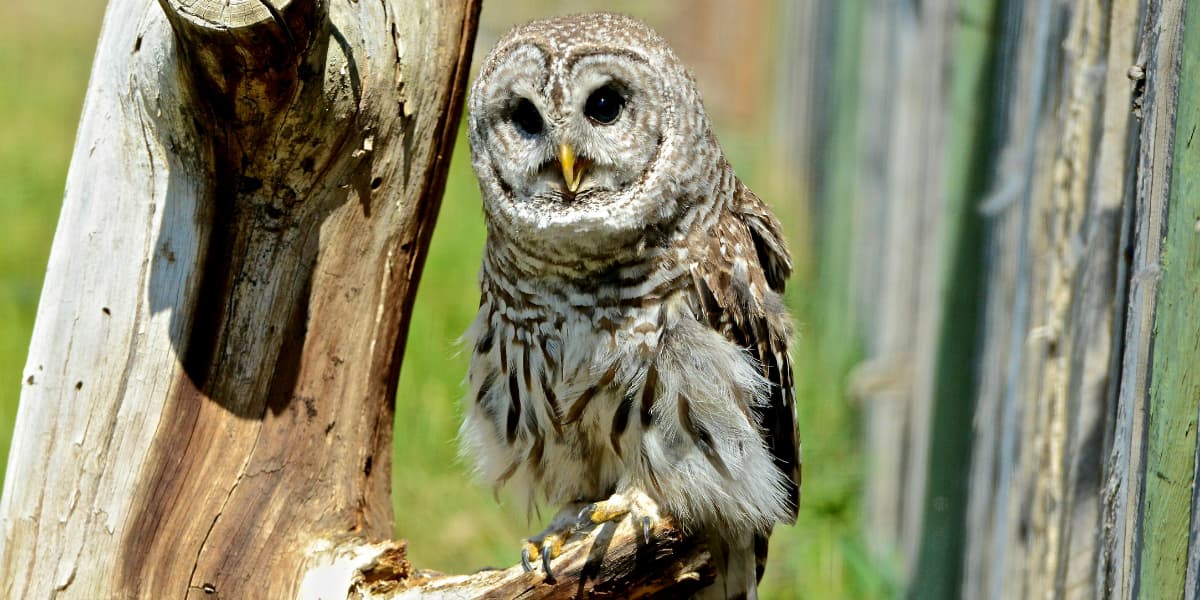
Barred owls look very different from barn owls. Instead of pale feathers and heart-shaped faces, barred owls are darker, fluffier, and covered in striped markings that give them their name.
Some of their most recognizable features include:
- Dark brown eyes that can look almost black
- Horizontal “barred” stripes across the chest
- Vertical streaking on the belly
- Large round heads with no ear tufts
- Thick fluffy feathers that make them look extra chunky
- Silent flight that makes surprise owl encounters feel way more dramatic
Barred Owl Size
People are often surprised by how big barred owls actually are when they see one in person. Photos really don’t do them justice, especially because they’re basically wearing a giant layer of feathers that makes them look even chunkier.
When perched, they can look rounded and almost cozy-looking. Then they open their wings and suddenly every squirrel in the forest remembers it has unfinished business somewhere else.
Barred owls are considered fairly large owls, though they aren’t the biggest owls in North America.
According to Cornell Lab of Ornithology’s All About Birds, a full grown barred owl typically measures:
- 16–20 inches tall
- 16–37 oz weight
- 39–44 inch wingspan
To give you a visual comparison, they’re a little smaller than a goose, though they look much bulkier because of all those feathers. And unlike geese, barred owls fly almost completely silently, which honestly feels unfair considering how large they are.
Barred Owl Size Comparison
Here’s how barred owls compare to some other common North American owl species:
Owl Species | Height | Average Weight |
|---|---|---|
| Burrowing Owl | 7–11 inches | 5–8 oz |
| Western Screech Owl | 7–10 inches | 4–9 oz |
| Barn Owl | 12–15 inches | 14–25 oz |
| Long-Eared Owl | 13–16 inches | 7–15 oz |
| Barred Owl | 16–25 inches | 16–40 oz |
| Great Horned Owl | 18–25 inches | 32–88 oz |
| Snowy Owl | 20–28 inches | 48–104 oz |
| Great Gray Owl | 24–33 inches | 32–64 oz |
Where Do Barred Owls Live?
Barred owls prefer mature forests with plenty of trees and access to water. You’ll commonly find them in:
- Woodlands
- Swamps
- River corridors
- Wet forests
- Suburban wooded neighborhoods
They’re especially common in the eastern United States, though their range has expanded westward over the last century into parts of the Pacific Northwest and California. In California, they’re much more common in Northern California and forested mountain regions than in Southern California.
Unlike some owl species that avoid humans completely, barred owls can adapt surprisingly well to suburban areas as long as there are enough trees and prey nearby.
You may hear them long before you ever see them.
What Do Barred Owls Eat?

Barred owls are opportunistic hunters, which basically means they aren’t particularly picky.
Their diet includes:
- Mice
- Rats
- Squirrels
- Rabbits
- Frogs
- Snakes
- Small birds
- Crayfish
- Fish occasionally
- Large insects
Like many owls, barred owls play an important role in natural rodent control. Healthy owl populations help keep ecosystems balanced naturally, without relying on dangerous rodenticides that can move up the food chain and poison wildlife.
How Do Barred Owls Hunt?
Barred owls are incredibly effective nighttime hunters. They usually hunt from elevated perches, quietly listening and watching for movement below before swooping down almost completely silently.
Most prey animals never hear them coming.
Like other owls, barred owls have several specialized adaptations that make them incredibly effective stealth hunters. They have:
- Specialized feathers that help muffle sound for silent flight
- Extremely sensitive hearing
- Forward-facing eyes for strong depth perception
- Powerful talons designed to grab and crush prey
They hunt mostly at night, but barred owls are actually more active during daylight hours than many other owl species. It’s not unusual to spot one hunting around dawn, dusk, or even during the day, especially in heavily shaded forests.

Barred Owl Sounds
The barred owl’s call is one of the most recognizable owl sounds in North America. Even people who know absolutely nothing about birds have usually heard one at some point and thought, “What on earth was that?”
Their classic call sounds like: “Who cooks for you? Who cooks for you all?”
But that’s far from the only sound they make.
Barred owls are surprisingly noisy and make all kinds of strange sounds, like:
- Hooting
- Cackling
- Screaming
- Gurgling
- Whistles
- Chaotic monkey-like calls that honestly sound mildly possessed
If you’ve ever heard bizarre jungle sounds coming from an American forest at night, there’s a decent chance a barred owl was involved somehow.
They’ll often call back and forth with mates, especially during breeding season, and sometimes entire forests sound like they’re hosting a very dramatic owl argument that nobody else was invited to.
Are Barred Owls Dangerous?
Most owls are not dangerous to humans and generally want nothing to do with us, and that includes barred owls.
They’d much prefer people stop wandering into the woods at night with flashlights, questionable situational awareness, and absolutely no understanding of what that noise in the trees actually was.
That said, barred owls can become defensive near nests or young owlets.
There have been reports of barred owls:
- Swooping at people
- Smacking heads or hats
- Clicking their beaks
- Vocalizing aggressively
This behavior is usually defensive, not predatory. In other words, the owl is trying to scare you away from its babies, not add you to the dinner menu.
If you encounter a defensive owl:
- Leave the area calmly
- Give nests plenty of space
- Avoid getting too close for photos
- Never feed wild owls
And while barred owls aren’t looking to attack humans, their talons are incredibly sharp. Even a quick defensive swipe from a large owl is something you definitely want to avoid.
Barred Owl Predators
Adult barred owls don’t have many natural predators, but they still face plenty of threats.
Predators and dangers include:
- Great horned owls
- Hawks
- Eagles
- Raccoons
- Snakes targeting eggs or chicks
- Cars
- Habitat loss
- Rodenticides
Ironically, one of the biggest threats to many owls isn’t another predator at all. It’s us.
Secondary poisoning from rodenticides is a major problem for raptors because poisoned rodents don’t just politely disappear after eating bait. They often become slow, weak, and easy to catch, which means the poison moves right up the food chain into owls, hawks, foxes, bobcats, and other wildlife.
Many common rodenticides interfere with vitamin K, preventing normal blood clotting. As a result, affected owls can suffer internal bleeding over several days, making rodenticide poisoning a particularly cruel and often fatal threat. Wildlife rehabilitators frequently observe symptoms such as lethargy and weakness, which can leave owls unable to hunt effectively or care for their young.
It’s something wildlife rehabilitators and researchers see over and over again, especially with birds of prey.

The Barred Owl Conservation Controversy
Barred owls have become part of one of the biggest and messiest owl conservation debates in North America.
Originally native to eastern North America, barred owls gradually expanded westward into parts of the Pacific Northwest and California. The problem is that these forests were already home to northern spotted owls and California spotted owls, species that were already struggling due to habitat loss.
Researchers found that barred owls are often:
- Larger
- More adaptable
- Less picky eaters
- More aggressive when competing for territory
In other words, barred owls are really good at being owls.
So, in an effort to help protect threatened spotted owl populations, the U.S. Fish and Wildlife Service has approved a Barred Owl Management plan that allows authorized wildlife professionals to lethally remove some barred owls in an effort to help protect threatened spotted owl populations.
The program could involve removing up to 470,000 barred owls over the next 30 years.
And to be very clear: This does not mean the public can legally kill barred owls.
Barred owls are still protected under federal law. The removals are limited to trained wildlife professionals operating under government-approved conservation permits.
It’s one of those conservation situations where scientists are trying to protect one struggling owl species without completely losing another.
Why Barred Owls Matter
Barred owls are a reminder that wildlife conservation is rarely simple. Even a species as iconic as the barred owl can become part of complicated ecological conflicts involving habitat loss, changing ecosystems, and human impact on wildlife.
And like so many raptors, barred owls do best when they have healthy habitats, safe prey, and a world with a little less poison moving through the food chain.
At Ramona Barn Owls, that’s a huge part of our mission. Through our 24/7 owl livestream, educational content, and wildlife outreach, we work to help people better understand owls and the important role they play in natural ecosystems.
You can help support that mission by learning about poison-free rodent control, watching our owl livestream, or even shopping our owl clothing line, which helps fund educational outreach and conservation awareness.
![Every Tee Tells a Story – From rescues to rodent control, our designs speak up for owls. [Shop Owl-Inspired Apparel]](https://ramonabarnowls.com/wp-content/uploads/Every-Tee-Tells-a-Story-1.jpg)
![Book the Fairy Owlet Mother – Bring Stacey’s owl magic to your school or event. [Book a Presentation]](https://ramonabarnowls.com/wp-content/uploads/Book-the-Fairy-Owlet-Mother-1.jpg)

![Matching fits for the whole flock. Because protecting wildlife is even sweeter when you do it together. [Shop the Family Collection]](https://ramonabarnowls.com/wp-content/uploads/Matching-fits-for-the-whole-flock-1.jpg)


![Ridiculously Soft Whoo-Wear [Shop Now]](https://ramonabarnowls.com/wp-content/uploads/Ridiculously-Soft-Whoo-Wear-1.jpg)
![Hoot Happiness Guarantee – Shop risk-free with free returns & exchanges. [Shop Now]](https://ramonabarnowls.com/wp-content/uploads/Hoot-Happiness-Guarantee-1.jpg)
![Subscribe on YouTube – Join 1,000+ owl lovers following our live owl adventures. [Subscribe Now]](https://ramonabarnowls.com/wp-content/uploads/Subscribe-on-YouTube-1.jpg)