Quick Facts: California Condor
- Scientific name: Gymnogyps californianus
- Largest flying bird in North America by wingspan
- Wingspan: up to 10 feet wide
- Weight: up to around 25 pounds
- Lifespan: more than 50 years
- Habitat: mountains, cliffs, rocky canyons, and open rugged landscapes
- Diet: scavengers that feed mostly on dead animals
- They almost went extinct in the 1980s
California Condor
The California condor is one of the rarest and most fascinating birds in North America, and it’s pretty amazing that they still exist at all when you look at how close they came to extinction.
By 1982, there were only 22 California condors left in the entire world. Now there are hundreds again thanks to one of the biggest wildlife conservation comeback stories in U.S. history.
What Does a California Condor Look Like?
The California condor — sometimes called a California vulture — is a type of New World vulture and shares a lot of features with birds like turkey vultures, including bald heads and soaring flight styles.
Adult condors are pretty easy to recognize once you know what you’re looking for.
They have:
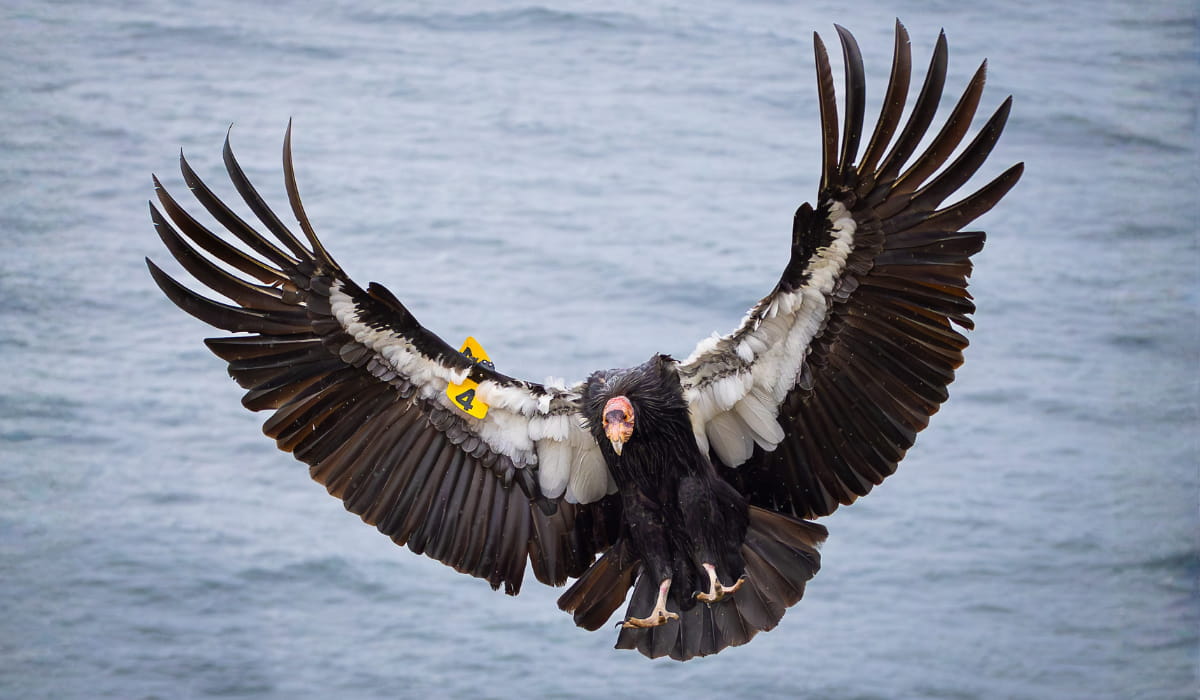
- huge black wings
- bright white patches underneath the wings
- featherless orange-pink heads
- broad soaring wings built for gliding long distances
Like many vultures, California condors are also surprisingly quiet birds because they do not have a well-developed syrinx, the vocal organ most birds use to make calls and songs. Instead, condors mostly communicate through grunts, hisses, and body language.
How Big Are California Condors?
California condors are absolutely massive birds.
A California condor’s wingspan can reach nearly 10 feet wide, making them the largest flying bird in North America by wingspan. They can also weigh up to around 25 pounds, which is enormous for a bird that spends most of its life soaring through the air.
For comparison, a large red-tailed hawk only weighs a couple pounds, and even bald eagles look relatively small next to condors.
One of the coolest things about condors is how little they actually flap their wings. Instead, they spend most of their time soaring and gliding through the air while barely moving their wings at all.
And because they’re such efficient flyers, condors can travel huge distances while searching for food and may fly more than 150 miles in a single day.

Photo courtesy of Shannon Sommer.
What Do California Condors Eat?
California condors are scavengers, which means unlike hawks and owls that actively hunt prey, they feed mostly on dead animals they find in nature.
That might sound gross at first, but scavengers are actually incredibly important for the environment because they help clean up carcasses before disease spreads. They’re basically nature’s cleanup crew.
Their bald heads actually help with this too. Since condors feed inside carcasses, having fewer feathers around the face helps keep bacteria and rotting material from sticking to them.
Historically, condors likely fed on massive Ice Age animals thousands of years ago. Today they feed on things like deer, livestock carcasses, and other large animals they find while soaring over open landscapes looking for food.
California Condor Habitat
Because condors are such massive birds, they need huge open landscapes to survive.
They also rely heavily on rising warm air currents called thermals to help them soar through the sky for hours without constantly flapping their wings.
That’s why condors do best in landscapes where those air conditions are most common, like:
- mountains
- cliffs
- rocky canyons
- grasslands
How California Condors Almost Went Extinct
California condors came incredibly close to disappearing forever.
By 1982, the wild California condor population had dropped to just 22 birds because of a combination of problems like:
- habitat loss
- poisoning
- collisions with power lines
- environmental contamination
But one of the biggest problems — and still one of the biggest problems today — was lead poisoning.
Because condors are scavengers, they feed on dead animals they find out in nature. The issue is that when hunters use lead ammunition, tiny little fragments of lead can stay behind inside carcasses or gut piles left in the field. Then condors accidentally eat those fragments while feeding.
And it really doesn’t take much lead to poison a bird that size.
At Ramona Barn Owls, we talk a lot about how toxins can travel up the food chain and affect far more wildlife than people realize. One of the biggest problems that many raptors face is rodenticides, where poisoned rodents are eaten by owls and other predators.
California condors are another powerful example of that same chain reaction happening in nature. It’s a reminder that what humans put into the environment can ripple through the entire ecosystem.
The Captive Breeding Program That Saved the Species
Things got so bad that wildlife officials eventually made a huge and very controversial decision to capture every single remaining wild condor and start a captive breeding program.
So for a short period of time, there were literally zero California condors left flying free in the wild.
At the time, a lot of people thought capturing the final wild condors was too risky and might permanently end the species in nature forever.
Instead, what followed became one of the largest wildlife recovery efforts in North America. The California Condor Recovery Program turned into a massive partnership between the U.S. Fish and Wildlife Service, zoos, conservation organizations, wildlife biologists, Indigenous tribes, veterinarians, researchers, and breeding facilities all working together to try to save the species.
Zoos and breeding centers carefully raised condors in captivity while trying to preserve as much genetic diversity as possible.
They even raised chicks using condor puppets so the babies would not imprint on humans and would continue behaving like wild condors once released.
A Slow and Steady Comeback
California condors reproduce incredibly slowly, which is one reason recovery has taken decades.
Condors can live 50 to 60 years or more in the wild and tend to form long-term pair bonds and invest huge amounts of time raising a single chick.
Unlike many birds, condors:
- don’t fully mature until around 6–8 years old
- usually raise only one chick every other year
- require long periods of parental care
- have both parents help raise the chick
That’s very different from birds like barn owls, which reproduce every year and often raise multiple babies in a single brood. Baby barn owls also reach their full adult size and weight in only about 8 to 10 weeks.
How Many California Condors Are Left Today?

Photo courtesy of Shannon Sommer.
According to the U.S. Fish & Wildlife Service:
- more than 600 condors now exist worldwide
- nearly 400 are currently flying free in the wild
- wild chicks are now successfully hatching in nature again
Even though the recovery of the California condor is considered one of the biggest wildlife conservation success stories in U.S. history, condors are still critically endangered and still need a lot of monitoring and protection.
Researchers still monitor threats like lead poisoning, habitat loss, and “microtrash,” where chicks accidentally ingest small pieces of human trash brought back to the nest by adults.
They tag condors with giant numbered wing tags to track the birds in the wild and monitor survival, nesting, and movement.
Most birds wear small leg bands instead, but condors cool themselves down by peeing on their legs, which is not exactly great for a tiny leg band. So the larger wing tags work much better for long-term tracking.
The long-term goal is to eventually have a fully self-sustaining wild population again.
Where Can You See California Condors?
Even though they’re called the “Californian” condor, they are not found only in California.
Thousands of years ago, condors actually ranged across huge parts of North America, from California all the way to Florida and from western Canada down into northern Mexico. But as the population declined, their range became smaller and smaller.
Today, wild condor populations mainly live in:
- California
- Arizona
- Utah
- Baja California, Mexico
A lot of people travel to places like Big Sur, Pinnacles National Park, and the canyon areas near the Grand Canyon hoping to look up and spot one soaring overhead, because seeing a California condor in the wild is kind of a bucket-list birding experience.
More Than Just a Rare Bird
California condors have become symbols of both how much damage humans can cause and what conservation can accomplish when people refuse to give up on a species.
Humans nearly pushed condors to extinction.
Humans also helped bring them back.
These birds are a powerful reminder of what the Ramona Barn Owls mission is all about too.
Whether we’re talking about owls, condors, or other birds of prey, so many of the threats are connected:
- toxins moving up the food chain
- habitat loss
- human impact on wildlife
Because what affects one species rarely stops with just one species.
And after coming that close to disappearing forever, the fact that California condors are still soaring through the sky at all feels pretty incredible.
![Every Tee Tells a Story – From rescues to rodent control, our designs speak up for owls. [Shop Owl-Inspired Apparel]](https://ramonabarnowls.com/wp-content/uploads/Every-Tee-Tells-a-Story-1.jpg)
![Book the Fairy Owlet Mother – Bring Stacey’s owl magic to your school or event. [Book a Presentation]](https://ramonabarnowls.com/wp-content/uploads/Book-the-Fairy-Owlet-Mother-1.jpg)

![Matching fits for the whole flock. Because protecting wildlife is even sweeter when you do it together. [Shop the Family Collection]](https://ramonabarnowls.com/wp-content/uploads/Matching-fits-for-the-whole-flock-1.jpg)


![Ridiculously Soft Whoo-Wear [Shop Now]](https://ramonabarnowls.com/wp-content/uploads/Ridiculously-Soft-Whoo-Wear-1.jpg)
![Hoot Happiness Guarantee – Shop risk-free with free returns & exchanges. [Shop Now]](https://ramonabarnowls.com/wp-content/uploads/Hoot-Happiness-Guarantee-1.jpg)
![Subscribe on YouTube – Join 1,000+ owl lovers following our live owl adventures. [Subscribe Now]](https://ramonabarnowls.com/wp-content/uploads/Subscribe-on-YouTube-1.jpg)