Quick Overview
- Owls don’t have “night vision” like goggles — but their eyes are exceptionally good at working in very low light.
- Barn owls are nighttime specialists, relying on low-light vision, precise depth perception, and extraordinary hearing to hunt.
- Owl eyes are unusually large and built to detect movement in dim conditions, not bright color.
- Forward-facing eyes and a heart-shaped facial disc help barn owls judge distance and locate prey — even in complete darkness.
- As effective natural rodent hunters, barn owls provide poison-free pest control by consuming thousands of rodents each year.
Do Owls Have Night Vision?
You may have heard—or just assumed—that owls have night vision. After all, they’re night hunters, so it kind of makes sense.
But let’s clear the air.
Owls don’t have superhero-style night vision goggles. There’s no glowing green overlay. No infrared scanning. No secret owl tech we don’t know about.
But what they do have is something arguably cooler: eyes and senses that are unbelievably good at working in very low light. Not total darkness—but moonlight, starlight, and those in-between moments when everything looks dim and fuzzy to us.
And when we’re talking about nighttime vision specialists, barn owls are in a league of their own.
Most Owls Are Nocturnal, and Their Vision Is Designed for Low Light
Most owl species are nocturnal or crepuscular, meaning they’re active at night or during twilight hours like dusk and dawn. That timing isn’t random. It’s directly tied to their prey.
Mice, voles, rats, and other small mammals are also most active after sunset. If you’re an owl whose dinner clock starts ticking at night, you’d better be able to see what you’re doing.
So over millions of years, owl eyes evolved to become exceptionally efficient in low-light conditions. Not total darkness, but moonlight, starlight, and even faint reflected light are more than enough for an owl to get the job done.

Owl Eyes Are Huge (And That’s on Purpose)
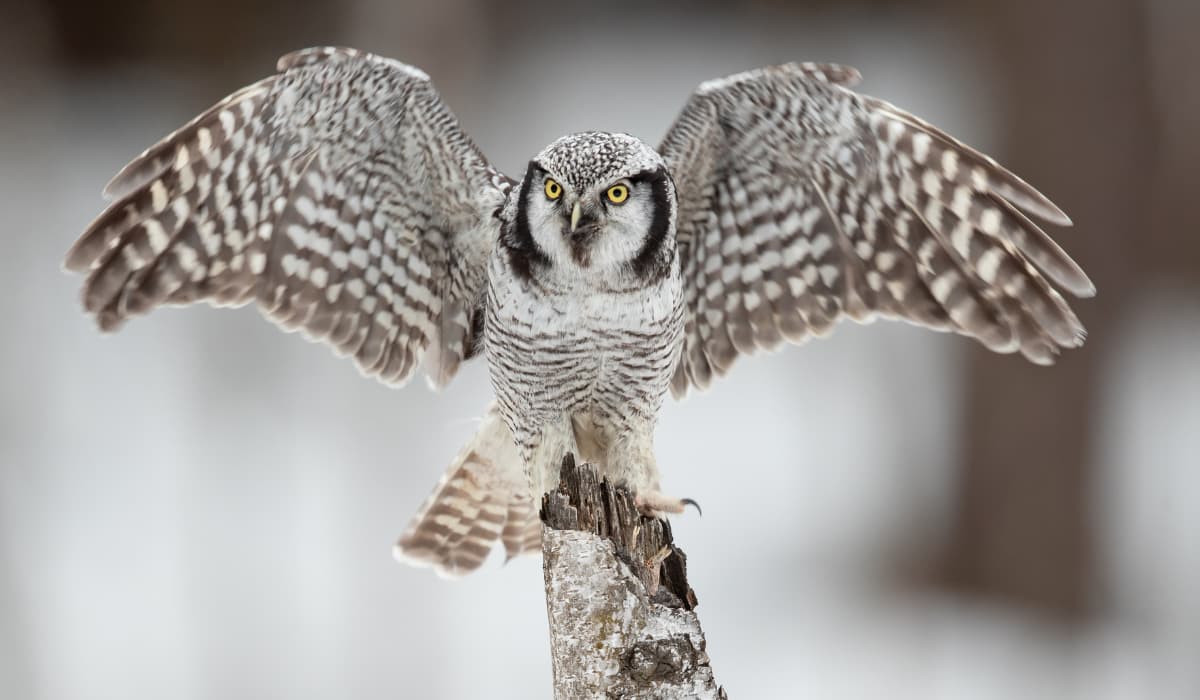
One of the first things you notice when you look at an owl is the eyes. They’re large, forward-facing, and give owls that intense, wise, slightly judgmental stare.
In many owl species, the eyes account for 1–5% of the bird’s total body weight. That’s enormous when you consider how lightweight birds need to be to fly. But those big eyes serve a critical purpose: they let in as much available light as possible.
More light in, means better vision when light is scarce.
It’s a simple equation—but an incredibly effective one.
The Anatomy of an Owl’s Eye: Built for the Dark
To understand why owls see so well at night, you have to look at what’s happening inside the eye.
At the back of the eye is the retina, the light-sensitive layer that receives visual information and sends it to the brain. The retina contains two main types of photoreceptor cells:
- Rods, which detect light and movement
- Cones, which detect color and fine detail
Owls are absolutely packed with rods.
On average, owls have about 30 rod cells for every cone cell. Humans, by comparison, have closer to 20 rods for every cone. That difference might not sound dramatic, but it completely changes how the world looks in low light.
Rod cells are extremely sensitive. They’re great at picking up faint light and noticing even the slightest movement—exactly what an owl needs when a mouse rustles through grass under a moonlit sky.
Rod-heavy vision means owls are incredibly good at:
- Detecting movement
- Seeing in very low light
- Spotting subtle changes in their environment
The tradeoff? Color vision takes a back seat. Because owls have fewer cones, they don’t see the world in bright, vivid color the way we do. Their view is more muted, shadow-based, and contrast-heavy.
Perfect for nighttime hunting. Less useful for appreciating a sunset.
Forward-Facing Eyes and the Shape of an Owl’s Face
It’s not just the size of an owl’s eyes that matters — it’s where they’re placed.
Because both eyes face forward instead of out to the sides, the areas each eye sees overlap.
That overlap creates binocular (3-D) vision, a trait owls share with humans and other predators. It allows them to judge distance with incredible accuracy — something that’s absolutely essential when you’re timing a silent midair strike.
In fact, owls have the most forward-facing eyes of any group of birds.
That’s no accident.
Prey animals, like rabbits or deer, usually have eyes on the sides of their heads. This gives them a much wider field of view, helping them spot danger coming from almost any direction. The tradeoff? Poor depth perception.
Owls went the opposite route. They sacrificed a wide panoramic view in exchange for pinpoint accuracy. An owl’s total field of view is about 110 degrees, with roughly 70 degrees of that being binocular vision. Humans, by comparison, have a wider overall field of view (around 180 degrees), but when it comes to judging distance, owls and humans are surprisingly similar.
Now add the barn owl’s facial disc into the picture.
That heart-shaped face isn’t just iconic — it’s functional. It acts like a satellite dish, funneling sound toward the owl’s ears. Vision and hearing work together so seamlessly that a barn owl can locate prey with astonishing precision… even when it can’t actually see it.
Yes, barn owls can strike prey in complete darkness using sound alone.
And because owls hunt at speed, often close to the ground, their eyes also come equipped with an extra layer of protection: nictitating membranes. These translucent “third eyelids” slide horizontally across the eye, shielding it from debris while still allowing the owl to see.

Owl Eyes Aren’t Round — They’re Tubes
Here’s one that almost always surprises people: owl eyes aren’t shaped like regular eyeballs at all.
Instead of being round, they’re long and tube-shaped. That shape helps owls gather more light, which is great for seeing at night — but it comes with a catch.
Those eye tubes are locked into place inside the skull by bony structures called sclerotic rings. Because of that, owls can’t move their eyes the way we can.
So to make up for it, owls just turn their whole head — sometimes up to 270 degrees.
Owls Can See During the Day, Too
There’s a common misconception that since owls can see so well at night, they are basically blind in daylight. Not true.
Owls can see perfectly well during the day. Their pupils simply adjust to let in less light, protecting the sensitive retina behind them.
If you’ve ever seen an owl during daylight hours with its eyes half-closed, it may not be sleeping. It might just be blocking out excess light, the way you squint on a bright afternoon.
Fun Facts About Owl Eyes
Now for the really eye-opening stuff.
- Owls have three eyelids (sort of). They have an upper eyelid that closes downward when blinking, a lower eyelid that closes upward when sleeping, and a nictitating membrane which is often called their third eyelid. It slides sideways across the eye, is semi-translucent, and helps protect and clean the eye while still allowing the owl to see. Nature really said, “Let’s add a windshield wiper.”
- Owl eyes don’t glow in the dark. If you’ve ever seen glowing owl eyes in the dark, or in a photo, that’s just light reflecting off the retina — similar to red-eye in human photos. Owls aren’t bioluminescent.
- Owls are long-sighted. Because of their eye shape, owls don’t focus well on objects that are close. To make up for it, they have specialized bristle-like feathers around their beaks called crines (or rictal bristles). These help them locate prey once it’s caught, sense nearby objects, and keep their beaks clean.
What This Teaches Us at Ramona Barn Owls
Understanding how owls see the world puts their role into perspective.
These raptors are highly specialized predators, shaped by evolution to do one job exceptionally well: hunt rodents efficiently, quietly, and naturally.
Thanks to their incredible low-light vision, precise depth perception, and ability to hunt by sound alone, barn owls are one of the most effective forms of natural pest control there is.
A single barn owl family can consume thousands of rodents in a year.
Which is exactly why the use of rodenticides is so dangerous.
When poison is used, it doesn’t stop with the rodent. It moves up the food chain, affecting barn owls and other wildlife that eat poisoned prey.
And as remarkable as owl vision at night is, it won’t help them see poison.
That’s where Ramona Barn Owls’ mission comes in.
We want to spread the word that you don’t have to rely on poison for pest control. By protecting barn owls and inviting them into your backyard, you’re supporting a solution that’s quieter, safer, and better for the entire ecosystem.
Protect the hunters, and they’ll keep doing what they’ve always done best.
How to Join the Mission
Some of the most impactful actions happen right at home.
Start by choosing poison-free pest control. Skipping rodenticides is one of the simplest and most effective ways to protect barn owls and other wildlife.
You can also support the mission by watching our live owl cam, where you’ll see barn owls in real time — hunting, nesting, and raising their young.
Another way to help is through our owl clothing line. Every purchase directly supports owl education, poison-free pest control outreach, rescue efforts, and the behind-the-scenes work that keeps this mission going.
![Every Tee Tells a Story – From rescues to rodent control, our designs speak up for owls. [Shop Owl-Inspired Apparel]](https://ramonabarnowls.com/wp-content/uploads/Every-Tee-Tells-a-Story-1.jpg)
![Book the Fairy Owlet Mother – Bring Stacey’s owl magic to your school or event. [Book a Presentation]](https://ramonabarnowls.com/wp-content/uploads/Book-the-Fairy-Owlet-Mother-1.jpg)

![Matching fits for the whole flock. Because protecting wildlife is even sweeter when you do it together. [Shop the Family Collection]](https://ramonabarnowls.com/wp-content/uploads/Matching-fits-for-the-whole-flock-1.jpg)


![Ridiculously Soft Whoo-Wear [Shop Now]](https://ramonabarnowls.com/wp-content/uploads/Ridiculously-Soft-Whoo-Wear-1.jpg)
![Hoot Happiness Guarantee – Shop risk-free with free returns & exchanges. [Shop Now]](https://ramonabarnowls.com/wp-content/uploads/Hoot-Happiness-Guarantee-1.jpg)
![Subscribe on YouTube – Join 1,000+ owl lovers following our live owl adventures. [Subscribe Now]](https://ramonabarnowls.com/wp-content/uploads/Subscribe-on-YouTube-1.jpg)