Quick Overview
- Owls do not hibernate.
- Most owls stay active all winter long.
- Some owl species migrate or move south seasonally.
- Owls survive winter using thick insulating feathers, incredible hearing, and efficient hunting skills.
- Some owls are actually more active and vocal during winter, especially during courtship season.
Do Owls Hibernate In the Winter?
A lot of animals seem to disappear during winter. Bears hibernate. Frogs bury themselves in mud. Bats vanish into caves. Even insects seem to disappear overnight.
But owls?
Owls are still out there. Hunting. Flying. Screaming into the darkness at 2 a.m.
And that’s because owls do not hibernate.
Instead, they stay active year-round and rely on a bunch of incredible adaptations to survive freezing temperatures, snow, rain, and food shortages during winter.
At Ramona Barn Owls, we actually get to watch this happen in real time on our 24/7 owl livestream. Barn owls don’t disappear when temperatures drop. They keep hunting, bonding, raising babies, and trying to survive winter one night at a time.
Why Don’t Owls Hibernate?
The simple answer is: they don’t need to.
Hibernation is a survival strategy some animals use when winter becomes too difficult. During hibernation, an animal dramatically slows its metabolism, heart rate, breathing, and body temperature to conserve energy when food is scarce.
Animals that hibernate usually survive off stored body fat until warmer weather returns.
Owls can’t do that.
They’re predators that need to eat regularly, so instead of sleeping through winter, they remain active and continue hunting throughout the season.
In fact, some owls are especially active during winter because it’s breeding season. Great horned owls, for example, often begin nesting while snow is still on the ground, while barn owls continue hunting rodents almost every night of the year.
Also, owls are extremely well-adapted for winter survival. As long as they can keep hunting, they can keep surviving through winter without needing to hibernate.
How Do Owls Survive Winter?
Owls survive winter using a combination of insulation, stealth, hearing, and energy conservation.
They’re honestly kind of built for it.
Thick Feathers Keep Them Warm
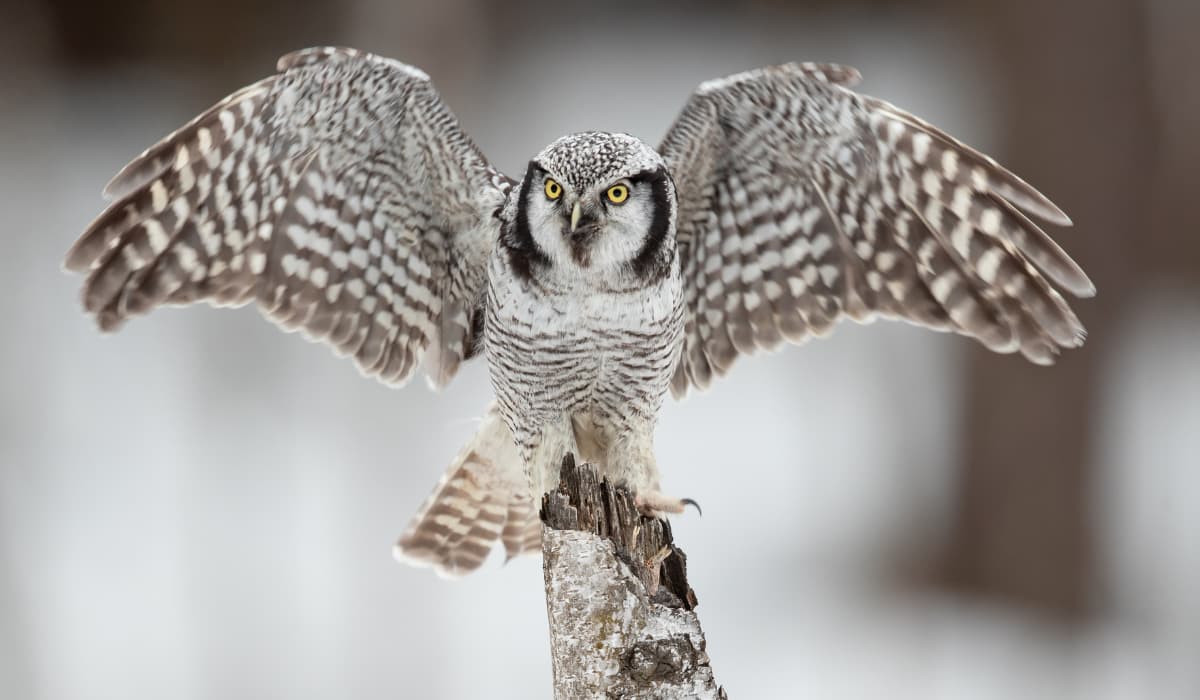
Owls have incredibly dense feathers that trap warm air close to the body.
Some species, like snowy owls, look almost comically fluffy because they have so much insulation packed into their feathers.
Many owls also fluff up their feathers during cold weather to create even more trapped air and warmth.
Their feet are often feather-covered too, which helps protect them from snow and freezing temperatures.
They Hunt Efficiently
Owls are energy-efficient hunters.
Instead of flying around nonstop wasting energy, many owls spend long periods perched quietly, listening for tiny movements below them.
Then — boom — they launch into short, precise hunting flights.
Barn owls especially rely heavily on sound. Their hearing is so sensitive they can often hunt successfully in near-total darkness using sound alone.
Some owls can even hear prey moving underneath snow. Snowy owls, for example, are capable of hearing small mammals beneath the surface before plunging down to grab them.
And sometimes those snow dives leave behind something pretty incredible: giant wing-shaped impressions in the snow often nicknamed “owl snow angels.” They happen when the owl spreads its wings during the strike, leaving behind a ghostly imprint where the hunt happened.
Do Barn Owls Hibernate?
No, barn owls do not hibernate either.
But winter can be pretty rough on barn owls compared to some other owl species. According to the Barn Owl Trust, winter is often the hardest season for barn owls, and mortality rates are highest between December and March, mainly because of starvation during prolonged bad weather.
Barn owls are not as well adapted for extremely cold or wet weather as some northern owl species, and long stretches of storms can make survival really difficult.
Unlike many birds, barn owls don’t have especially waterproof feathers. And because they rely so heavily on sound while hunting, bad weather can completely mess with their ability to find food. Heavy rain, strong wind, deep snow, and frozen ground can all make hunting much harder.
So how do they survive?
- They save energy whenever possible: Instead of flying around nonstop burning calories, barn owls often hunt from fence posts, branches, or poles while quietly listening for movement below.
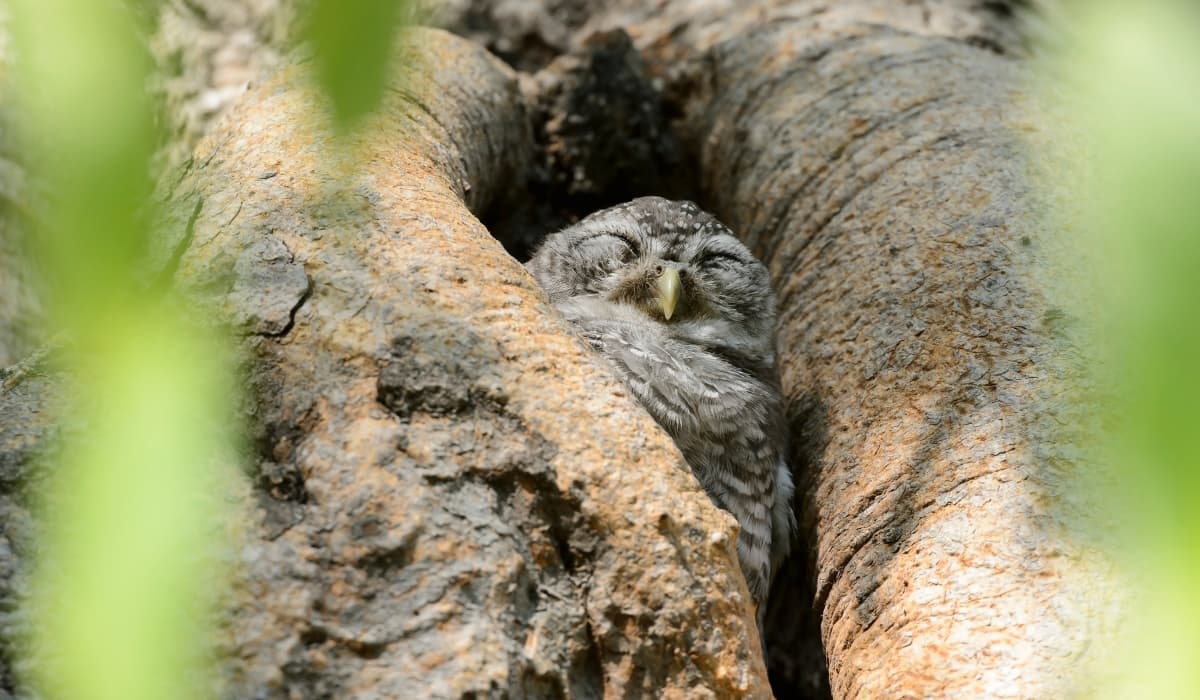
- They look for sheltered places to roost: During storms or freezing weather, barn owls try to stay protected in places like barns, tree cavities, abandoned buildings, owl boxes, and dense vegetation.
- They sometimes change their hunting habits: Even though barn owls are mostly nocturnal, they may occasionally hunt during daylight hours in winter if food is scarce or nighttime hunting conditions are especially bad.
- They rely on incredibly sensitive hearing: Barn owls primarily hunt by sound, which works amazingly well most of the time — but strong wind and heavy rain can interfere with their ability to hear prey movement clearly.
Do Owls Migrate?
Some do.
But migration is very different from hibernation.
Hibernation means an animal basically powers down for winter. Migration means moving from one area to another seasonally — usually to find food, better weather, or better hunting conditions.
And owls? They’re kind of all over the place depending on the species.
Some owls stay in the exact same territory year-round. Others suddenly show up hundreds or even thousands of miles away during winter.
Which Owls Migrate During Winter?
Some owl species are migratory, while others are more nomadic and move around depending on food availability. The ones that tend to migrate are:
- Snowy owls: Probably the most famous winter travelers. Every few years, large numbers suddenly appear much farther south than normal in an event called an “irruption,” usually when Arctic food supplies — especially lemmings — change dramatically.
- Northern saw-whet owls: These tiny little owls migrate seasonally too, but most people never notice because they travel mostly at night. They’re kind of secretive little potatoes with wings.
- Short-eared owls: Short-eared owls may shift southward during winter depending on prey populations and weather conditions.
- Long-eared owls: Some long-eared owls migrate, while others stay put year-round depending on where they live.
- Burrowing owls: Some burrowing owl populations migrate, while others remain year-round residents in warmer areas.
Which Owls Stay in the Same Area Year-Round?
A lot of owls are actually pretty loyal to their territories and stick around all year long. That includes species like:
- Barn owls: Barn owls usually stay surprisingly local year-round unless weather conditions or food shortages force them to move.
- Barred owls: These woodland owls typically remain in the same territory throughout the year.
- Great horned owls: Great horned owls are year-round residents and often begin nesting during winter instead of migrating.
- Eastern screech owls: These small owls generally stay close to the same territory year-round.
- Western screech owls: Like their eastern relatives, western screech owls usually remain in the same area throughout winter.
Instead of migrating, these owls survive winter by adjusting their behavior — conserving energy, changing hunting patterns, and finding sheltered places to roost during storms.
Where Do Owls Go During Winter?
Usually… not very far.
Migratory owl species may head south or move into areas with better hunting opportunities during winter, but many owls stay surprisingly close to their normal territory year-round.
Snowy owls may travel down from Arctic breeding grounds into parts of Canada and the northern United States during winter. Other species may shift from deep forests into grasslands, farmland, marshes, or open hunting areas where rodents are easier to find.
But many owls simply adapt to winter conditions instead of leaving.
At Ramona Barn Owls, winter is actually one of the most interesting times to watch owl behavior on the owl livestream. Some nights are incredibly active. Other nights, storms keep the owls tucked away longer.
But they’re still there.
Still hunting. Still bonding. Still surviving.
Which Owls Are More Active During Winter?
Some owls actually get more active during winter because it’s breeding season.
Great horned owls are famous for nesting incredibly early — sometimes while snow is still covering the ground.
Barred owls, screech owls, and great horned owls also become more vocal during colder months as they defend territories and communicate with mates.
And winter can actually be one of the best times to hear owls calling.
Cold air carries sound really well, trees lose their leaves, and suddenly those nighttime owl calls feel even louder and creepier in the best possible way.
Winter Isn’t the Only Danger Owls Face
Winter can be difficult for owls. Storms, freezing temperatures, deep snow, and food shortages all make survival harder.
But natural winter conditions are not the only threat owls face.
Rodent poison has become one of the biggest dangers to owls today.
Owls eat rodents. When those rodents consume poison, the toxins move up the food chain and can poison the predators too.
That’s why we’ve made it our mission to educate people about the dangers of rodenticides and the importance of poison-free pest control.
If you’d like to support that mission, you can shop our owl clothing line, tune into our 24/7 owl livestream, and help us spread awareness about protecting barn owls and other wildlife.
Final Answer: Do Owls Hibernate?
No. Owls do not hibernate.
Instead, they survive winter using incredible adaptations like insulating feathers, specialized hearing, efficient hunting skills, and sheltered roosting spots.
Some owls migrate or move seasonally, but most remain active year-round.
Barn owls are no exception.
Even during freezing nights, storms, and food shortages, barn owls continue hunting, surviving, and raising families one night at a time.
![Every Tee Tells a Story – From rescues to rodent control, our designs speak up for owls. [Shop Owl-Inspired Apparel]](https://ramonabarnowls.com/wp-content/uploads/Every-Tee-Tells-a-Story-1.jpg)
![Book the Fairy Owlet Mother – Bring Stacey’s owl magic to your school or event. [Book a Presentation]](https://ramonabarnowls.com/wp-content/uploads/Book-the-Fairy-Owlet-Mother-1.jpg)

![Matching fits for the whole flock. Because protecting wildlife is even sweeter when you do it together. [Shop the Family Collection]](https://ramonabarnowls.com/wp-content/uploads/Matching-fits-for-the-whole-flock-1.jpg)


![Ridiculously Soft Whoo-Wear [Shop Now]](https://ramonabarnowls.com/wp-content/uploads/Ridiculously-Soft-Whoo-Wear-1.jpg)
![Hoot Happiness Guarantee – Shop risk-free with free returns & exchanges. [Shop Now]](https://ramonabarnowls.com/wp-content/uploads/Hoot-Happiness-Guarantee-1.jpg)
![Subscribe on YouTube – Join 1,000+ owl lovers following our live owl adventures. [Subscribe Now]](https://ramonabarnowls.com/wp-content/uploads/Subscribe-on-YouTube-1.jpg)