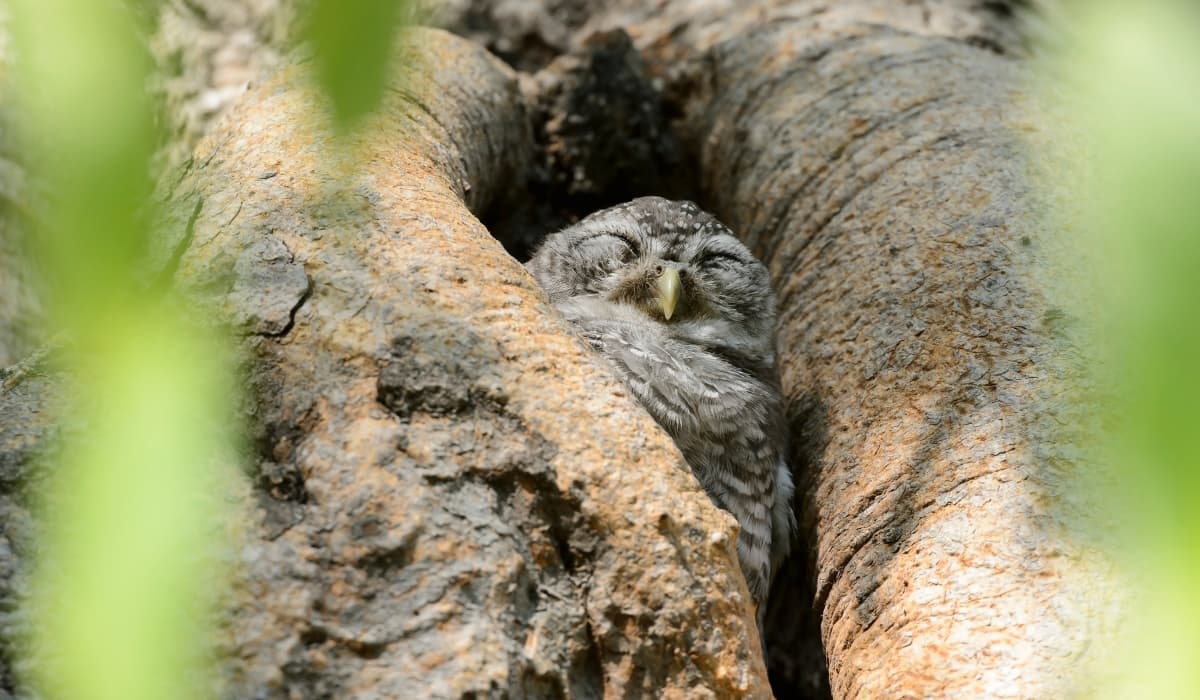
Long-Eared Owl Facts
- The long-eared owl (Asio otus) is a medium-sized owl found across North America, Europe, and parts of Asia
- It is easily recognized by its tall ear tufts and bright orange eyes
- The long-eared owl prefers dense forests but often hunts in open fields and grasslands
- The long-eared owl feeds mainly on small mammals, especially rodents
- Its nests are usually repurposed from old crow or hawk nests rather than built from scratch
Meet the Long-Eared Owl
The long-eared owl is one of the best-hidden owls out there. They don’t just blend in—they disappear.
It is one of those owls you could walk right past and never know it was there.
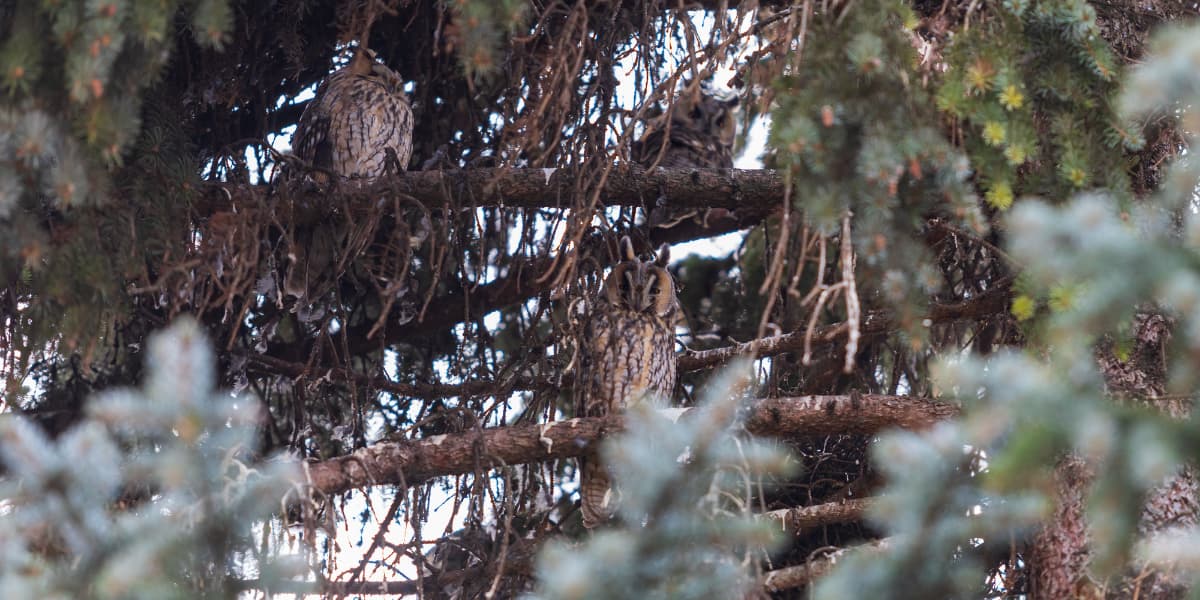
What looks like a cluster of broken branches might actually be a group of owls roosting together, perfectly still, completely unnoticed.
And then, just as quietly, they’re gone—slipping out into the night to hunt.
There’s a lot more going on with this species than meets the eye. From their unusual roosting behavior to the way they use sound and camouflage, they’re full of surprises.
Let’s take a closer look.
What Do Long-Eared Owls Look Like?
Long-eared owls have a very distinct look once you know what to look for.
They typically measure around:
- 13–16 inches tall
- Wingspan of about 35–40 inches
- Weight around 8–15 ounces
Key features include:
- Tall, upright ear tufts
- Bright orange eyes
- A narrow, elongated body
- Mottled brown and buff feathers for camouflage
When they feel threatened, they do something incredible—they stretch their body upward, flatten their feathers, and close their eyes to slits. Suddenly, they look exactly like a broken tree branch.
It’s one of the best camouflage tricks in the owl world.

Long-Eared Owl Feathers and Flight
Long-eared owl feathers aren’t just for warmth or camouflage. Their mottled brown and buff coloring allows them to disappear into tree bark during the day, but it’s the structure of those feathers that really sets them apart.
They’re highly specialized tools that help these birds hunt with incredible precision—an adaptation shared by many owl species.
Each feather has a soft, fringed edge that breaks up airflow during flight. Instead of creating noise like most birds, this design muffles sound, allowing them to move through the air almost completely silently.
That silence is everything.
When a long-eared owl is flying, it’s not relying on speed or strength—it’s relying on stealth. It glides low over open ground with slow, controlled wingbeats, scanning and listening at the same time.
And, because their ears are slightly uneven, they can detect tiny differences in sound timing. That means even if a vole is moving under grass or snow, they can pinpoint its exact location without ever seeing it.
Once they lock in, the movement is quick and precise—a silent drop straight down onto their prey.
It’s a hunting strategy that depends entirely on a combination of flight, feather structure, and sound.
And it’s incredibly effective.
Where Do Long-Eared Owls Live?
They’re found across much of North America, Europe, and parts of Asia, making them one of the more widely distributed owl species.
Long-eared owls prefer a mix of habitats that gives them both cover and hunting space.
You’ll usually find them in:
- Dense forests or woodlands (for roosting and nesting)
- Open fields, grasslands, or meadows (for hunting)
- Shelterbelts or tree lines near farmland

Long-Eared Owl Behavior: Masters of Staying Hidden
Long-eared owls are nocturnal, meaning they’re most active at night.
During the day:
- They roost quietly in dense foliage
- They rely almost entirely on camouflage
- They remain extremely still—even when approached
At night:
- They hunt low over open ground
- They fly with slow, buoyant wingbeats
- They rely heavily on sound to locate prey
Unlike some more territorial species, they can tolerate being near others, especially outside of breeding season.
Some populations migrate seasonally, while others stay in the same area year-round. It all depends on food availability.
Long-Eared Owl Roosting Behavior
Long-eared owls rely heavily on dense tree cover during the day, where their camouflage helps them stay completely hidden.
But unlike many other owls, they don’t always roost alone.
In winter, they often gather in communal roosts, with multiple owls tucked into the same cluster of trees. At first glance, it can look like nothing more than a patch of branches—until you realize there are several owls sitting perfectly still.
These groups aren’t social—they’re simply sharing a safe, sheltered place to rest.
This behavior is one of the reasons they’re such a sought-after species for birders and photographers. Finding multiple owls in one spot is rare, but these roosts can also be sensitive, so it’s important to observe from a distance and avoid disturbing them.
What Do Long-Eared Owls Eat?
Long-eared owls are highly specialized hunters, with a diet heavily focused on small mammals.
Their prey includes:
- Voles (a major staple)
- Mice
- Small rats
- Occasionally small birds
In many areas, voles make up the majority of their diet, which we know through owl pellet analysis.
Their hunting style is simple but effective:
- Low, slow flight over open ground
- Listening for movement below
- A sudden, silent drop to capture prey

Nesting and Raising Young
Unlike many birds, long-eared owls don’t build their own nests.
Instead, they rely on:
- Abandoned crow nests
- Old hawk nests
- Occasionally squirrel nests
They typically lay:
- 3–6 eggs
- Incubation lasts about 3–4 weeks
- Chicks leave the nest in about 4–5 weeks
The female stays with the eggs and young, while the male does most of the hunting.
Once they find a good nesting area, they often return to it year after year.

What Do Long-Eared Owls Sound Like?
They’re not the most talkative owls—but when they do call, you’ll notice.
During breeding season, their vocalizations become more distinct. The male’s call is a low, deep “hoo,” evenly spaced and repeated, echoing through the night. It may sound subtle, but it carries surprisingly far—sometimes up to 1 kilometer (about 0.7 miles) away.
Around the nest, things sound a little different. You might hear soft squeaks, whines, or even hissing sounds, especially from younger birds or when they feel threatened.
Overall, though, they tend to be much quieter than many other owl species—especially compared to the louder, more recognizable calls you’ll hear in common owl sounds at night.
Why These Owls Matter
Long-eared owls play an important role in keeping ecosystems balanced.
By feeding on:
- Rodents
- Small mammals
They help naturally control populations that could otherwise explode.
While not currently endangered, their populations can still be affected by habitat loss and food availability.
And just like barn owls and other birds of prey, they face a serious threat: rodenticide poisoning.
When poisoned rodents are eaten by predators, that toxin doesn’t just disappear—it moves up the food chain.
It’s the same ripple effect we see across ecosystems again and again.
Final Thoughts
Long-eared owls are quiet, patient, and almost impossible to spot—but they’re out there, working every single night.
They’re part of the same system as barn owls, hawks, and even scavengers like vultures. And when one part of that system is affected, everything else feels it.
That’s exactly why our mission at Ramona Barn Owls matters.
We’re here to raise awareness about the impact of rodenticides and promote safer, poison-free ways to manage pests—so these birds can continue doing the job they were meant to do.If you want to be part of that mission you can support poison-free pest control by sharing what you’ve learned, tuning into our live barn owl cameras, or wearing our owl clothing line and starting the conversation about conservation.
FAQs About Long-Eared Owls
How big is the long-eared owl?
The long-eared owl size typically ranges from about 13 to 16 inches tall, with a wingspan of 35 to 40 inches. Despite their length, they are lightweight birds, usually weighing between 8 and 15 ounces.
What is the long-eared owl range?
The long-eared owl range spans across North America, Europe, and parts of Asia. They are one of the more widely distributed owl species in the Northern Hemisphere.
What is the long-eared owl habitat?
The long-eared owl habitat includes dense forests or woodlands for roosting, paired with nearby open fields, grasslands, or meadows for hunting. They rely on both cover and open space to survive.
What is special about the long-eared owl’s flight?
Long-eared owl flying is slow, quiet, and buoyant. They glide low over open ground, using silent wingbeats and exceptional hearing to locate prey before dropping down to capture it.
Do long-eared owls migrate?
Some long-eared owls migrate seasonally, while others stay in the same area year-round. Their movement largely depends on food availability, especially the presence of small mammals like voles.
Why do long-eared owls roost in groups?
Long-eared owls roost in groups during the winter to take advantage of safe, sheltered areas with good cover. These communal roosts help them stay protected from weather and predators, rather than serving a social purpose.
How long do long-eared owls live?
In the wild, long-eared owls typically live around 4 to 10 years, though some individuals can live longer under the right conditions.
![Every Tee Tells a Story – From rescues to rodent control, our designs speak up for owls. [Shop Owl-Inspired Apparel]](https://ramonabarnowls.com/wp-content/uploads/Every-Tee-Tells-a-Story-1.jpg)
![Book the Fairy Owlet Mother – Bring Stacey’s owl magic to your school or event. [Book a Presentation]](https://ramonabarnowls.com/wp-content/uploads/Book-the-Fairy-Owlet-Mother-1.jpg)

![Matching fits for the whole flock. Because protecting wildlife is even sweeter when you do it together. [Shop the Family Collection]](https://ramonabarnowls.com/wp-content/uploads/Matching-fits-for-the-whole-flock-1.jpg)


![Ridiculously Soft Whoo-Wear [Shop Now]](https://ramonabarnowls.com/wp-content/uploads/Ridiculously-Soft-Whoo-Wear-1.jpg)
![Hoot Happiness Guarantee – Shop risk-free with free returns & exchanges. [Shop Now]](https://ramonabarnowls.com/wp-content/uploads/Hoot-Happiness-Guarantee-1.jpg)
![Subscribe on YouTube – Join 1,000+ owl lovers following our live owl adventures. [Subscribe Now]](https://ramonabarnowls.com/wp-content/uploads/Subscribe-on-YouTube-1.jpg)