Short-Eared Owl Quick Facts:
- Scientific name: Asio flammeus
- Range: Found across North America, South America, Europe, Asia, and parts of Africa
- Height: 13–17 inches
- Weight: 7–17 ounces
- Wingspan: 33–43 inches
- Activity: One of the most diurnal owl species, meaning they’re often active during the day
- Nesting: Nest directly on the ground
- Diet: Primarily hunt rodents like voles and mice
- Habitat: Prefer open grasslands, marshes, and fields instead of forests
Short-Eared Owl
Short-eared owls are one of the most unusual owls in North America because they do not really act the way most people expect owls to act.
Instead of hiding deep in forests all day, these owls spend a surprising amount of time out in the open. They fly low over fields, hunt around sunrise and sunset, rest directly on the ground, and even build nests down in tall grasses instead of trees.
They are also one of the few owl species people regularly see during daylight hours, which makes them feel very different from the more mysterious nighttime owls most people picture.
Why Are They Called Short-Eared Owls?
This confuses a lot of people because short-eared owls barely look like they even have ears.
Unlike great horned owls with giant dramatic feather tufts, short-eared owls have very tiny ear tufts that are often completely invisible unless the bird raises them.
Most of the time their heads actually look pretty round.
Short-Eared Owl Size
Short-eared owls are considered medium-sized owls.
Most adults are:
- around 13–17 inches tall
- about 7–17 ounces in weight
- equipped with wingspans between 33–43 inches
Their long broad wings make them look much larger in flight than they actually are.
They also have a very distinctive flying style.
Instead of powerful direct flight, short-eared owls tend to bounce and glide low across open ground with slow floppy wingbeats.
What Do Short-Eared Owls Look Like?
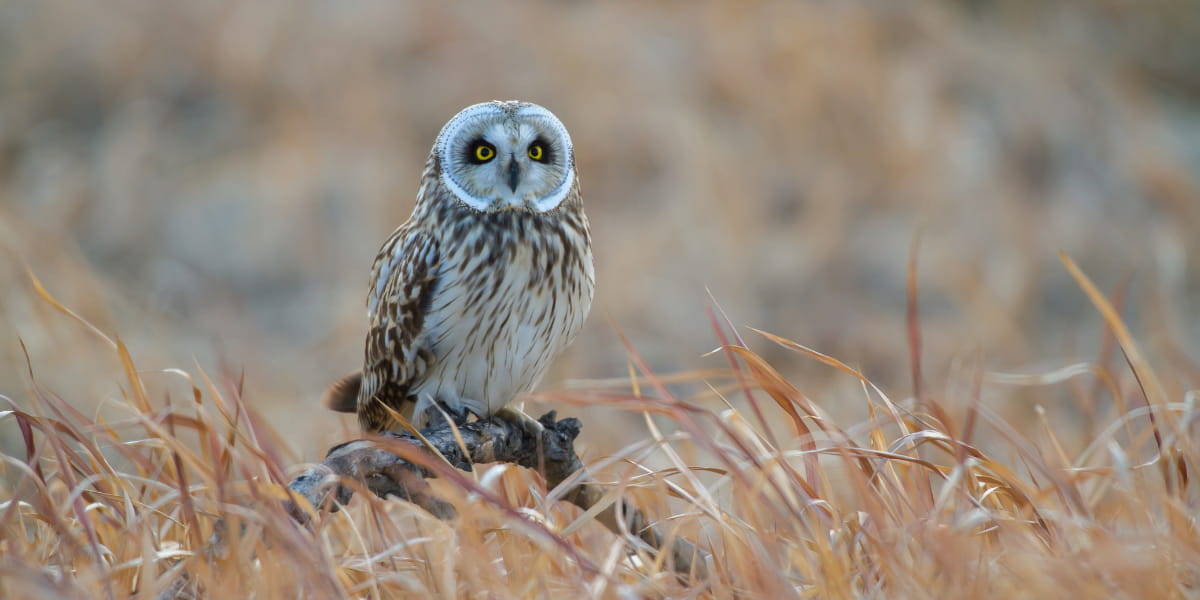
Short-eared owls have camouflage coloring that blends almost perfectly into dry grasses and marshlands.
They usually have:
- mottled brown, tan, and buff feathers
- bright yellow eyes
- pale facial disks
- dark outlines around the eyes
- streaked chests
- dark patches underneath the wings
One of the easiest ways to identify them in flight is the dark markings near the wrist area underneath their wings.
Short-Eared Owl Habitat
Short-eared owls prefer wide open landscapes where they can hunt close to the ground.
Their favorite habitats include:
- grasslands
- marshes
- prairies
- meadows
- coastal dunes
- agricultural fields
- tundra
Dense forests usually aren’t a good fit for them because they rely on open visibility while hunting.
Healthy grassland ecosystems are extremely important for short-eared owls because they support large rodent populations.
Unfortunately, habitat loss has caused declines in many areas.
Some of the biggest threats to short-eared owls include:
- development
- destruction of grasslands
- vehicle strikes
- disturbance near nesting areas
- rodent poison exposure
Because they spend so much time near the ground, they’re also vulnerable to collisions and habitat disruption in ways some tree-dwelling owls are not.
Where Do Short-Eared Owls Live?
Short-eared owls are found across huge parts of the world, including North America, South America, Europe, Asia, and parts of Africa.
In North America, they live throughout:
- Canada
- much of the United States
- parts of Mexico
Some populations migrate seasonally, especially birds living farther north. During certain times of year, birds may move farther south in search of food and better hunting conditions.
Short-eared owls are also native to Southern California, although they are not commonly seen compared to some other local owl species.
Short-Eared Owls Spend a Lot of Time on the Ground

One of the quirkiest things about short-eared owls is how much time they spend on the ground.
They regularly:
- rest on the ground
- roost in grassy fields
- hunt low over the ground
- build nests directly on the ground
This is very different from what most people picture when they think about owls.
A lot of owl species prefer tree cavities, cliffs, barns, or elevated nesting locations. Short-eared owls instead hide their nests deep inside tall grasses and thick vegetation.
That camouflage helps protect them from predators, but it also means people can accidentally disturb nests without even realizing they are there.
Short-Eared Owl Diet
Short-eared owls mostly eat small mammals.
Like many raptors, short-eared owls help naturally control rodent populations. Their diet commonly includes:
- voles
- mice
- rats
- shrews
- small rabbits occasionally
- small birds sometimes
Voles are especially important. In fact, short-eared owl populations often rise and fall depending on vole populations in an area.
How Short-Eared Owls Hunt
Short-eared owls hunt differently than many other owls.
Instead of quietly waiting on a branch, they actively patrol open land while flying.
They typically:
- fly low over grasses
- listen for rodent movement below
- suddenly drop feet-first onto prey
- hunt most actively around dawn and dusk
Their hearing is extremely important while hunting.
Even when prey is hidden underneath thick grass, they can often detect movement below the surface.

Are Short-Eared Owls Active During the Day?
Yes. Short-eared owls are considered one of the more diurnal owl species, meaning they are often active during daylight hours.
People regularly spot them:
- near sunrise
- around sunset
- sometimes during winter afternoons
This daytime activity is one reason wildlife photographers love them so much. They are often easier to observe than fully nocturnal owl species.
Short-Eared Owl Nesting Habits
Baby short-eared owls hatch inside nests hidden directly on the ground.
Females usually lay:
- about 4–7 eggs
- sometimes more during years when food is plentiful
And honestly, food makes a huge difference for owls.
When vole and rodent populations are high, short-eared owls often raise more babies successfully because there is simply more food available for everyone.
After hatching:
- chicks grow quickly
- they leave the immediate nest area before fully flying
- they hide throughout nearby grasses for protection
That last part is actually pretty smart because it helps lower the chances of a predator finding all the babies at once.
Baby short-eared owls start out covered in fluffy pale down before eventually growing in their darker juvenile feathers.
The Story of Lucky the Short-Eared Owl
One of the most memorable short-eared owl experiences we’ve had at Ramona Barn Owls involved a rescued owl named Lucky.
Our Fairy Owlet Mother, Stacey Mae Rudge, received a phone call from someone saying a couple from Orange County was driving in with an injured owl after seeing Ramona Barn Owls shirts and rescue information.
The owl had reportedly been attacked by a hawk near a beach boardwalk in Orange County. A photographer named Kenny witnessed the attack, managed to intervene, and rescued the owl after the hawk dropped it.
When Stacey first saw Lucky, she immediately noticed something was wrong with his posture.
His head remained tilted to one side.
After sending photos and videos to her mentor Mike for identification, he explained the tilt likely indicated neurological damage from trauma.
Stacey brought frozen mice, gloves, and supplies to help support the owl while the rescuers attempted rehabilitation.
Over the following days, they stayed in contact constantly:
- monitoring whether Lucky was eating
- tracking his progress
- supplying additional food
- hoping his condition would improve
For a short time, he actually seemed to be doing a little better.
But sadly, Lucky eventually passed away from his injuries.
Even though the ending was heartbreaking, Stacey still describes the experience as a blessing because short-eared owls are such uncommon birds to encounter up close.
There was also one unexpectedly positive outcome from the experience.
The couple involved in Lucky’s rehabilitation became so inspired by the process that the husband later pursued his falconry license.
That’s one of the things wildlife education often does.
Even difficult stories can inspire people to care more deeply about birds, conservation, and protecting wildlife in the future.
Helping Protect More Owls Like Lucky
There is not much you can do about a hawk attacking an owl. That was nature simply doing its thing, and unfortunately Lucky was just dealt a very unfair hand.
But there are a lot of human-caused dangers we can help reduce for owls and other raptors, including:
- rodent poisons
- habitat loss
- litter and pollution
- disturbing nesting areas
That is a huge part of the mission behind Ramona Barn Owls.
Through our 24/7 owl livestream, educational owl content, and the RBO owl clothing line, we hope to continue to fund more education, outreach, rescues, and conservation efforts for owls and other wildlife.
Short-Eared Owl FAQs
Why Are They Called Short-Eared Owls?
Short-eared owls get their name from the tiny feather tufts on top of their heads. Unlike great horned owls, their “ears” are so small they are often hard to see.
Do Owls Sit on the Ground?
Yes. Short-eared owls are actually known for spending a lot of time on the ground. They often rest, hunt, and even nest in tall grasses and open fields where their camouflage helps them blend in.
Are short-eared owls nocturnal?
Short-eared owls are partially nocturnal, but they are also one of the more diurnal owl species. Many people see them hunting around sunrise, sunset, and even during daylight hours.
What Do Short-Eared Owls Eat?
Short-eared owls mainly eat small rodents like voles, mice, rats, and shrews. They help naturally control rodent populations by hunting low over fields and grasslands.
![Warning: Highly Addictive Baby Owl Content. Peek into the nest 24/7 and fall in love with our live owls. [Watch the Livestream]](https://ramonabarnowls.com/wp-content/uploads/Warning-1.jpg)
![Book the Fairy Owlet Mother – Bring Stacey’s owl magic to your school or event. [Book a Presentation]](https://ramonabarnowls.com/wp-content/uploads/Book-the-Fairy-Owlet-Mother-1.jpg)


![Caught on Cam: My bros fall, flop, and sass it up—watch the bloopers on YouTube. [Watch Now]](https://ramonabarnowls.com/wp-content/uploads/Caught-on-Cam-1.jpg)
![Subscribe on YouTube – Join 1,000+ owl lovers following our live owl adventures. [Subscribe Now]](https://ramonabarnowls.com/wp-content/uploads/Subscribe-on-YouTube-1.jpg)

![Your New Favorite Hoodie Is Saving Owls. Literally. Ridiculously soft. Seriously impactful. [Shop the Collection]](https://ramonabarnowls.com/wp-content/uploads/Your-New-Favorite-Hoodie-1.jpg)
![Hoot Happiness Guarantee – Shop risk-free with free returns & exchanges. [Shop Now]](https://ramonabarnowls.com/wp-content/uploads/Hoot-Happiness-Guarantee-1.jpg)