Burrowing Owl Quick Facts
- Ground-nesting owl: Unlike most owls, burrowing owls live underground in burrows often dug by animals like ground squirrels.
- Active during the day: They’re one of the few owls you can regularly see in daylight, though they also hunt at night.
- Small but bold: Burrowing owls are only about 7–10 inches tall, but their long legs and bright yellow eyes give them a big personality.
- Found across the Americas: These owls live from western North America through Central and South America wherever open grasslands and burrowing animals exist.
Burrowing Owls
When most people imagine an owl, they picture a silent hunter perched high in a tree, gliding through the night sky in search of prey.
Burrowing owls didn’t get that memo.
Instead of living in trees, these little owls live underground—popping up from burrows in the middle of open grasslands like tiny feathered prairie dogs. And unlike most owls that hide during the day, burrowing owls are often out in broad daylight.
They’re small, long-legged, endlessly curious, and full of personality.
You might see one perched on a fence post, sprinting across a field after an insect, or peeking out of its burrow like a tiny feathered security guard keeping watch over the prairie.
In other words, if most owls follow the traditional owl rulebook, burrowing owls tossed it out completely.
What Makes Burrowing Owls So Unique?
Most owls nest in tree cavities, cliff ledges, or abandoned nests high off the ground.
Burrowing owls decided to go in the opposite direction.
They live underground.
They usually take over burrows dug by animals like prairie dogs and ground squirrels—though in some places, they can excavate or modify burrows too.
These underground tunnels become their homes, nesting chambers, and safe place to raise chicks.
And that’s not the only rule they break.
When it comes to when they’re active and out hunting, burrowing owls flipped the script there too.
Are Burrowing Owls Nocturnal?
Most owls are nocturnal, meaning they do their hunting at night while the rest of the world is asleep.
Burrowing owls… are flexible.
They’re actually considered primarily diurnal, which means they’re often active during the day. It’s very normal to see one standing outside its burrow in broad daylight, looking around like a tiny security guard keeping watch over the grasslands.
But that doesn’t mean they clock out when the sun goes down.
Burrowing owls will hunt during the day and at night depending on what food is available and whether they have hungry chicks waiting at home.
During the day, they tend to go after insects like beetles and grasshoppers.
At night, they’re more likely to hunt small mammals like mice and voles.
So instead of sticking to a strict night shift like many owls, burrowing owls are more like the overachievers of the owl world… working both shifts when they need to.
And their daytime activity is one reason people get to observe burrowing owls more often than other owl species. It’s not uncommon to see one standing outside its burrow in the middle of the afternoon, scanning the horizon like a tiny prairie lookout.
They’re alert. Curious. And very aware of everything happening around them.
Where Do Burrowing Owls Live?

Burrowing owls prefer open landscapes where they can easily spot predators and hunt for food.
Burrowing owl habitats include:
- Grasslands
- Desert plains
- Agricultural fields
- Coastal prairies
- Open scrubland
They live across the Americas, from western North America all the way down through Central and South America. Wherever there are wide open landscapes and animals digging burrows in the ground, burrowing owls can usually find a place to live.
In California, they are most often found in grasslands and open valleys, especially in areas where burrowing mammals like ground squirrels already live.
Because their burrows are so important, some areas of Southern California now protect active burrowing owl habitat, limiting development where owls are nesting—which may frustrate some developers but makes a lot of owl lovers very happy.
And in places where natural burrows have already been lost, conservation groups and wildlife managers sometimes install artificial burrow systems to give burrowing owls a safe place to nest and encourage them to settle in protected habitat.
At Ramona Barn Owls, we have a protected area right next to us, which is wonderful because it prevents developers from building on the land. Although Ramona Barn Owls doesn’t currently stream the burrowing owls, our partners at the Wildlife Research Institute (WRI) have protected areas close by in our grasslands and a neighboring field for study. We’ve had the chance to see them in person—they are so cute!
Burrowing Owl Size: Small but Full of Personality
Burrowing owls are among the smallest owls in North America, but they make up for it with a lot of personality.
Typical burrowing owl measurements:
- Height: 7–10 inches tall
- Wingspan: 20–24 inches
- Weight: 5–8 ounces
Small. Compact. And surprisingly bold.
But don’t let their size fool you. Burrowing owls are alert, expressive, and full of character.
What Do Burrowing Owls Look Like?
Burrowing owls are easy to recognize once you know what to look for.
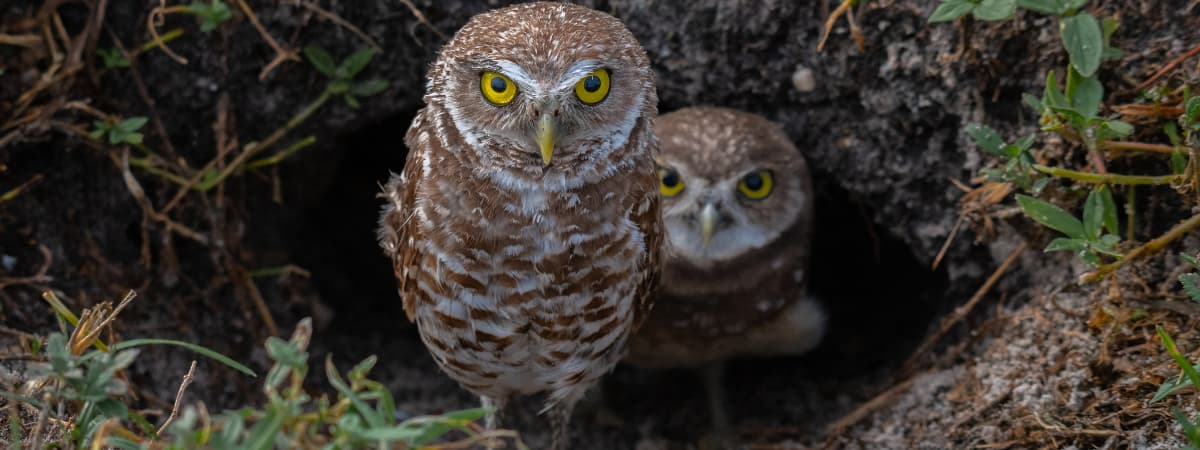
They have bright yellow eyes, a round facial disk, and expressive white “eyebrow” markings that give them a permanently curious look.
Burrowing owls’ feathers are usually brown with white spots on the head and wings and light barring across the chest, which helps them blend into dry grasslands and desert landscapes.
Unlike some owls, burrowing owls don’t have ear tufts, giving their heads a smooth, rounded appearance.
One of their most noticeable features, though, is their long legs. Those long legs help them run, hop, and move quickly across open terrain while hunting insects and other small prey.
When standing outside their burrow entrance, those legs also make them appear a little taller than you might expect for such a small owl.
Can Burrowing Owls Fly?

Yes—burrowing owls can absolutely fly, even though they spend a lot of time on the ground.
Their flight style just looks a little different from larger owls. Instead of soaring high overhead like hawks or great horned owls, burrowing owls usually fly low and fast across open ground, often in short bursts between perches.
Their flight is typically direct, slightly undulating, and nearly silent, which helps them sneak up on prey.
You’ll often see them flying from:
- Rock to rock
- Fence post to fence post
- One mound of dirt to another
They’ll also launch into quick flights to catch insects in mid-air or swoop down on rodents moving through the grass.
So even though you’ll often see them standing outside their burrow like tiny feathered lookouts, they’re still very capable fliers when the moment calls for it.
What Do Burrowing Owls Eat?

Burrowing owls are opportunistic hunters, which means they eat whatever prey is most available in their habitat.
Their diet commonly includes:
Insects
- Beetles
- Grasshoppers
- Crickets
Small mammals
- Mice
- Voles
- Young ground squirrels
Other prey
- Small birds
- Reptiles
- Amphibians
Because they often share habitats with burrowing mammals, food sources can be right outside their front door.
Convenient hunting territory.
Burrowing owls typically hunt by watching from a perch or standing near their burrow entrance before darting forward to grab prey on the ground.
Small body. Lightning-fast reflexes.
Burrowing Owl Nests
For burrowing owls, the burrow itself becomes the nest.
Inside the underground tunnel, the female creates a nesting area where eggs are laid and chicks are raised safely below the surface.
The burrow protects the nest from:
- Predators
- Extreme temperatures
- Harsh weather
Burrows can be surprisingly long—often several feet—and typically end in a larger nesting chamber.
Female burrowing owls typically lay between 2 and 12 eggs, which is a relatively large clutch compared to many owl species.
While the female stays inside the burrow incubating the eggs, the male hunts and brings food back to the nest.
Burrowing owls also use a clever strategy around the entrance of their burrows. Before laying eggs, they sometimes carpet the entrance with animal dung, which attracts dung beetles and other insects that the owls can catch and eat right outside their home
Once the chicks hatch, the burrow entrance becomes the cutest little stage in the owl world.
Tiny owl heads begin popping up outside the burrow long before they can fly, and it’s incredibly adorable.
Conservation Concerns: Why Burrowing Owls Need Protection
Despite their adaptability, burrowing owls face serious conservation challenges.
The biggest threat is habitat loss.
Urban development, agriculture, and land construction can destroy the burrows these owls depend on. Without underground tunnels—or the mammals that dig them—burrowing owls lose their homes.
Because of this, many areas now protect known burrowing owl habitats. In some regions, construction cannot take place if active burrowing owl burrows are present.
According to the Burrowing Owl Conservation Network, the survival of these owls is closely tied to the protection and maintenance of habitat, ground digging mammals and ecosystems.
Wildlife researchers and conservation organizations like the WRI also support owl populations by:
- Installing artificial burrow systems
- Monitoring nesting colonies
- Protecting grassland ecosystems
- Educating communities about wildlife-friendly land management
These conservation efforts are crucial to keeping burrowing owl populations stable across California.
Fun Burrowing Owl Facts
Here are a few facts that make these little owls even more fascinating.
- They bob their heads when alert. Head-bobbing helps them judge distance and stay aware of their surroundings.
- They can mimic rattlesnakes. Young burrowing owls sometimes make a hissing sound similar to a rattlesnake, which can scare predators away from the burrow.
- They’re surprisingly social. In some areas, burrowing owls live in loose colonies where multiple burrows exist within the same field.
Protecting Burrowing Owls
Burrowing owls may not have the dramatic wingspan of a great horned owl or the ghostlike glide of a barn owl.
But they play an incredibly important role in the ecosystem.
These little ground-dwelling hunters help control insect and rodent populations, keeping grasslands and agricultural areas in balance.
But unfortunately, like many other owls in Southern California and across the Americas, they are facing a threat that’s almost invisible.
Rodent poison.
When rodents eat poison and owls eat those rodents, the toxins move up the food chain. This secondary poisoning, can slowly kill owls and other raptors even though they never touched the poison themselves.
Burrowing owls can be especially vulnerable because they often share habitat with ground squirrels and gophers—the animals most commonly targeted by rodenticide programs. Gassing is also a major issue; people often use gas to kill gophers, and it tragically kills the burrowing owls using those same tunnels. These squirrels and gophers dig the very burrows burrowing owls rely on for their homes, which means the owls are often living and hunting in the exact areas where poison or gas may be used.
At Ramona Barn Owls, our goal is simple:
Protect owls by educating people about poison-free pest control and the incredible role owls play in our environment.
Instead of poisoning rodents, we can let owls do the job they’ve been doing for thousands of years.
How You Can Support Our Mission
You can support owl conservation in simple but meaningful ways:
- Avoiding rodent poison and choosing wildlife-friendly pest control
- Protecting natural habitats where owls can hunt and nest
- Watching and sharing our owl livestreams to help spread awareness
- Shopping our mission-driven owl clothing brand that funds education and outreach
Every small action helps protect the owls that share our landscapes.
![Every Tee Tells a Story – From rescues to rodent control, our designs speak up for owls. [Shop Owl-Inspired Apparel]](https://ramonabarnowls.com/wp-content/uploads/Every-Tee-Tells-a-Story-1.jpg)
![Book the Fairy Owlet Mother – Bring Stacey’s owl magic to your school or event. [Book a Presentation]](https://ramonabarnowls.com/wp-content/uploads/Book-the-Fairy-Owlet-Mother-1.jpg)

![Matching fits for the whole flock. Because protecting wildlife is even sweeter when you do it together. [Shop the Family Collection]](https://ramonabarnowls.com/wp-content/uploads/Matching-fits-for-the-whole-flock-1.jpg)


![Ridiculously Soft Whoo-Wear [Shop Now]](https://ramonabarnowls.com/wp-content/uploads/Ridiculously-Soft-Whoo-Wear-1.jpg)
![Hoot Happiness Guarantee – Shop risk-free with free returns & exchanges. [Shop Now]](https://ramonabarnowls.com/wp-content/uploads/Hoot-Happiness-Guarantee-1.jpg)
![Subscribe on YouTube – Join 1,000+ owl lovers following our live owl adventures. [Subscribe Now]](https://ramonabarnowls.com/wp-content/uploads/Subscribe-on-YouTube-1.jpg)