Quick Overview:
- Most owls sleep during the day because they are primarily nocturnal hunters.
- Adult owls usually sleep standing upright while gripping branches or perches with locking tendons in their feet.
- Many owls tuck one leg into their feathers like a flamingo
- Baby barn owls often sleep flattened on their stomachs
- Barn owls prefer enclosed sleeping spaces like tree cavities, barns, silos, and owl boxes.
- The Ramona Barn Owls livestream gives viewers a rare look at the weird, funny, and adorable sleeping habits of barn owls.
How Do Owls Sleep?
Sleeping owls are pretty cute.
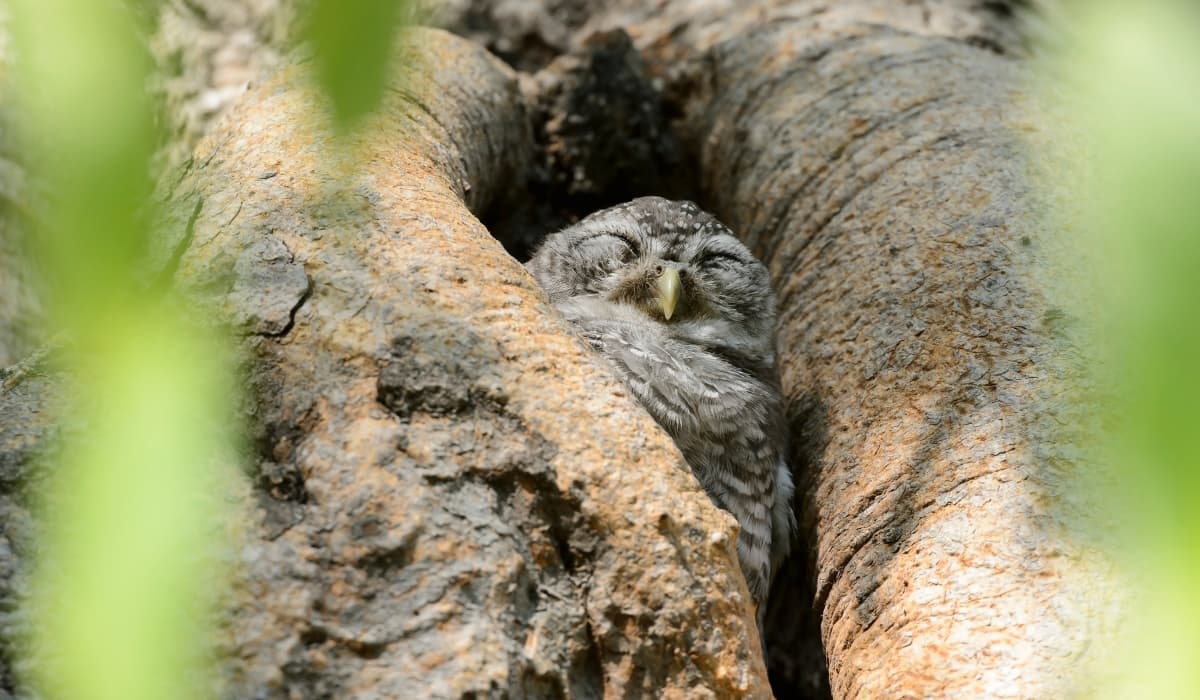
Depending on the species and age, they may sleep standing upright on one leg, tucked deep inside tree cavities, hidden against tree bark, or flattened face-down on the floor.
Some owl sleeping positions are adorable. Others are mildly concerning.
Thanks to the Ramona Barn Owls 24/7 livestream, we get a front-row seat to all the weird, funny, and adorable little things barn owls do while they sleep.
Where Do Owls Sleep?
Where owls sleep depends a lot on the species, the habitat, and whether they are raising babies.
Some owls, like great horned owls and barred owls, usually sleep perched high in dense trees where their feathers help camouflage them against branches and bark. Smaller owls, like screech owls, often sleep tucked safely inside tree cavities or abandoned woodpecker holes.
Not all owls sleep in trees though.
Burrowing owls are one of the biggest exceptions because they actually sleep underground in burrows, often ones originally dug by animals like ground squirrels or prairie dogs.
Barn owls prefer enclosed spaces like tree cavities, cliffs, barns, silos, abandoned buildings, and other sheltered spaces with protection from weather and predators, which is why they adapt to owl boxes so well.
A properly designed barn owl box basically mimics the kind of cavity they would naturally choose in the wild.
Do Owls Sleep Standing Up?
Most adult owls do sleep standing up.
Like many birds, they have special locking tendons in their feet that help them grip automatically while they sleep, so they do not just randomly fall off their perch in the middle of a nap.
Sometimes they’ll also tuck one leg up into their feathers to stay warm, which makes them look a little like tiny feathery flamingos.
We also often see our barn owls droop their heads forward or backward while dozing off, kind of like the same sleepy little head-bob humans do when they’re trying not to fall asleep on the couch.
How Do Baby Owls Sleep?
Baby owls sleep very differently from adults, and many species have some pretty funny-looking sleeping positions when they are young.
Baby barn owls are especially entertaining to watch.
Unlike the adults, barn owl owlets sleep completely flattened on their stomachs with their faces turned sideways against the nest floor. Their heads grow incredibly fast, but their neck muscles are still developing, so laying flat helps keep them from toppling over while they sleep.
When the babies are little, the whole family often sleeps piled together in one fluffy heap. They wrap themselves around each other in big fuzzy cuddle puddles, kind of like puppies trying to stay warm.
Sometimes it gets so fluffy and tangled together that we genuinely cannot tell where one owl ends and another begins.
And when the babies are very young, mom is usually part of the cuddle pile too.
Even after the eggs hatch, the mama barn owl still sits over the babies to keep them warm because they can’t regulate their own body temperature yet. Mama owls develop something called a brood patch, which is a featherless warm area on their belly that works almost like a built-in heated blanket.
As the babies get older though, things start getting… crowded.
Barn owl babies grow fast, and once they reach the wingersizing stage, where they begin aggressively flapping and strengthening their wings before fledging, the nest box starts feeling less like a peaceful cuddle session and more like a tiny feathered studio apartment with seven roommates who are all sick of each other.
Dust starts flying everywhere. Wings smack siblings in the head. Sometimes they get annoyed and start biting at each other too.
We’ve even seen one owl vomit up a pellet while another sibling was peacefully sleeping nearby… and accidentally hit it directly in the head.
Do Owls Sleep During the Day?
Yes, most owls are nocturnal which means they are usually awake at night and sleep during the day.
Barn owls are primarily nocturnal too, so nighttime is when they are usually hunting, flying, feeding babies, screaming dramatically, or aggressively searching for rodents.
During the day, they typically sleep or quietly rest inside sheltered roosting spots.
That said, owls do not always follow a perfect sleep schedule. Sometimes they wake up briefly during the day, especially during breeding season when there are hungry babies involved.
And sometimes at night, after huge feeding sessions, owlets will take a quick little “food coma” nap. One minute they are screaming for food, and the next they are completely unconscious face-down in the nest box.
Do Owls Dream?
They definitely look like they do sometimes.
We’ve seen owlets twitching, making funny facial expressions, moving their feet, or sleeping with one eye partly open, which looks a whole lot like dreaming behavior.
But whether they are actually dreaming is up for debate.
Researchers at the Max Planck Institute for Ornithology and the University of Lausanne studying barn owl sleep found that young owls spend a lot more time in REM sleep than adults do. REM sleep is the stage most associated with dreaming in humans and many animals, and human babies do this too.
They also found that baby barn owls with darker feather spots tended to spend slightly less time in REM sleep, suggesting the same genes linked to feather coloring may also influence brain development and adult traits later in life.
No one can prove an owl is actually dreaming during REM sleep, of course.
But if they are dreaming, we’d bet at least some of those dreams involve rodents!
Watching Barn Owls Sleep on the RBO Livestream
One of the coolest parts of the Ramona Barn Owls livestream is getting to watch these little behaviors most people would never normally see in the wild.
The sleeping.
The cuddle puddles.
The dramatic faceplants.
The sibling annoyance.
The more time you spend watching owls, the more you realize they somehow manage to be majestic predators and tiny exhausted toddlers at the exact same time.
Our mission with the livestream is to educate people and help them fall in love with barn owls, because we believe people are far less likely to harm the animals they care about.
We hope people who tune in learn that healthy owl families need safe nesting spaces, stable habitats, and rodenticide-free environments to successfully raise babies year after year.
You can help support the mission by watching the livestream, sharing owl education, or wearing something from our owl clothing line. Sometimes an owl T-shirt, hoodie, joggers, or hat is enough to start a conversation that helps someone see owls differently.
And once you’ve watched an owlet faceplant into a family cuddle puddle, it gets pretty hard not to fall in love with them.
Frequently Asked Questions
Where do owls sleep?
Owls sleep in different places depending on the species. Some sleep high in dense trees, some hide inside tree cavities, and burrowing owls even sleep underground.
Where do owls go during the day?
During the daytime, owls usually roost in hidden protected areas where predators and people are less likely to bother them. Many stay tucked into trees, cavities, barns, or other sheltered spaces while they rest.
Are owls nocturnal?
Most owl species are nocturnal, but not all of them. Some owls, like snowy owls and short-eared owls, are often active during the daytime too.
Do owls sleep standing up?
Yes. Most adult owls sleep standing upright while gripping their perch with special locking tendons in their feet.
How long do owls sleep?
Sleep patterns vary depending on the owl species, but most owls sleep for around 10 to 12 hours during the daytime since they are primarily nocturnal and active at night.
What time do owls go to sleep?
Most nocturnal owls begin settling down around sunrise after nighttime hunting. They usually sleep throughout much of the day before becoming active again around dusk, which also helps them avoid many daytime predators like hawks and other birds that may harass or attack owls during daylight hours.
![Every Tee Tells a Story – From rescues to rodent control, our designs speak up for owls. [Shop Owl-Inspired Apparel]](https://ramonabarnowls.com/wp-content/uploads/Every-Tee-Tells-a-Story-1.jpg)
![Book the Fairy Owlet Mother – Bring Stacey’s owl magic to your school or event. [Book a Presentation]](https://ramonabarnowls.com/wp-content/uploads/Book-the-Fairy-Owlet-Mother-1.jpg)

![Matching fits for the whole flock. Because protecting wildlife is even sweeter when you do it together. [Shop the Family Collection]](https://ramonabarnowls.com/wp-content/uploads/Matching-fits-for-the-whole-flock-1.jpg)


![Ridiculously Soft Whoo-Wear [Shop Now]](https://ramonabarnowls.com/wp-content/uploads/Ridiculously-Soft-Whoo-Wear-1.jpg)
![Hoot Happiness Guarantee – Shop risk-free with free returns & exchanges. [Shop Now]](https://ramonabarnowls.com/wp-content/uploads/Hoot-Happiness-Guarantee-1.jpg)
![Subscribe on YouTube – Join 1,000+ owl lovers following our live owl adventures. [Subscribe Now]](https://ramonabarnowls.com/wp-content/uploads/Subscribe-on-YouTube-1.jpg)